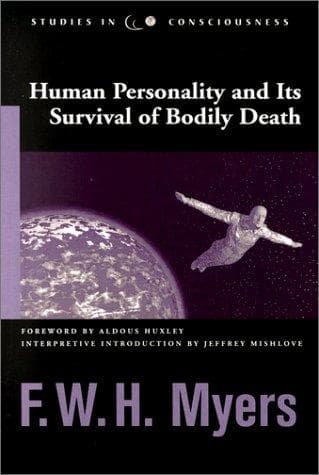
Human Personality and Its Survival of Bodily DeathMyers, F. W. H. (Frederic William Henry)
Religion
Human Personality and Its Survival of Bodily Death
Myers, F. W. H. (Frederic William Henry)
Immortality; Parapsychology; Personality
"There is first the popular view, that the apparition is something
belonging to the external world--that, like ordinary matter, it occupies
and moves through space, and would be in the room whether the percipient
were there to see it or not. This hypothesis involves us in many
difficulties, of which one serious one--that of accounting for the
clothes of the ghost--has often been urged, and never, I think,
satisfactorily answered. Nevertheless, I am bound to admit that there is
some little evidence tending to suggest this theory. For instance, in
the account,[158] of which I have given an abstract, of the weeping lady
who has appeared so frequently in a certain house, the following passage
occurs:--'They went after it (the figure) together into the
drawing-room; it then came out, and went down the aforesaid passage
(leading to the kitchen), but was the next minute seen by another Miss
[M.] ... come up the outside steps from the kitchen. On this particular
day, Captain [M.'s] married daughter happened to be at an upstairs
window ... and independently saw the figure continue her course across
the lawn and into the orchard.' A considerable amount of clear evidence
to the appearance of ghosts to independent observers in successive
points in space would certainly afford a strong argument for their
having a definite relation to space; but in estimating evidence of this
kind it would be necessary to know how far the observer's attention had
been drawn to the point in question. If it had been a real woman whom
the Miss [M.'s] were observing, we should have inferred, with perfect
certainty, from our knowledge that she could not be in two places at
once, that she had been successively, in a certain order, in the places
where she was seen by the three observers. If they had noted the moments
at which they saw her, and comparing notes afterwards, found that
according to these notes they had all seen her at the same time, or in
some other order to that inferred, we should still feel absolute
confidence in our inference, and should conclude that there must be
something wrong about the watches or the notes. From association of
ideas, it would be perfectly natural to make the same inference in the
case of a ghost which looks exactly like a woman. But in the case of the
ghost the inference would not be legitimate, because, unless the
particular theory of ghosts which we are discussing be true, there is no
reason, so far as we know, why it should not appear in two or more
places at once. Hence, in the case of the ghost, a well-founded
assurance that the appearances were successive would require a careful
observation of the times, which, so far as I know, has never been made.
On the whole, therefore, I must dismiss the popular theory as not
having, in my opinion, even a _primâ facie_ ground for serious
consideration.
Public-domain text, read in full here on John Shaqi.
Reviews
Reviews
No reviews yet
Be the first to share your thoughts on this work.
Elsewhere in the archive
Join the Discussion
Join the discussion
Sign in to leave a comment or review.
Sign InorCreate an account