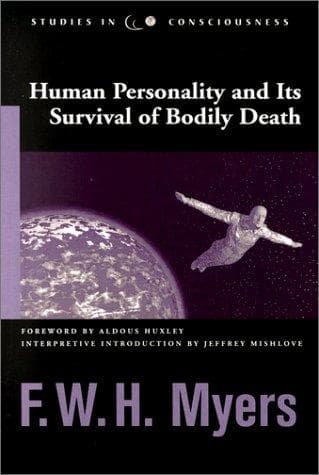
Human Personality and Its Survival of Bodily DeathMyers, F. W. H. (Frederic William Henry)
Religion
Human Personality and Its Survival of Bodily Death
Myers, F. W. H. (Frederic William Henry)
Immortality; Parapsychology; Personality
In the first place, then, our automatisms are _independent_ phenomena;
they are what the physician calls _idiognomonic_. That is to say, they
are not merely symptomatic of some other affection, or incidental to
some profounder change. The mere fact, for instance, that a man writes
messages which he does not consciously originate will not, when taken
alone, prove anything beyond this fact itself as to the writer's
condition. He may be perfectly sane, in normal health, and with nothing
unusual observable about him. This characteristic--provable by actual
observation and experiment--distinguishes our automatisms from various
seemingly kindred phenomena. Thus we may have to include in our class
the occasional automatic utterance of words or sentences. But the
continuous exhausting vociferation of acute mania does not fall within
our province; for those shouts are merely _symptomatic_; nor, again,
does the _cri hydrocéphalique_ (or spontaneous meaningless noise which
sometimes accompanies water on the brain); for that, too, is no
independent phenomenon, but the direct consequence of a definite lesion.
Furthermore, we shall have to include in our class certain simple
movements of the hands, co-ordinated into the act of writing. But here,
also, our definition will lead us to exclude _choreic_ movements, which
are merely symptomatic of nervous malnutrition; or which we may, if we
choose, call _idiopathic_, as constituting an independent malady. But
our automatisms are not _idiopathic_ but _idiognomonic_; they may indeed
be associated with or facilitated by certain states of the organism, but
they are neither a symptom of any other malady, nor are they a malady in
themselves.
Agreeing, then, that our peculiar class consists of automatisms which
are idiognomonic,--whose existence does not necessarily imply the
existence of some profounder affection already known as producing
them,--we have still to look for some more positive bond of connection
between them, some quality common to all of them, and which makes them
worth our prolonged investigation.
Public-domain text, read in full here on John Shaqi.
Reviews
Reviews
No reviews yet
Be the first to share your thoughts on this work.
Elsewhere in the archive
Join the Discussion
Join the discussion
Sign in to leave a comment or review.
Sign InorCreate an account