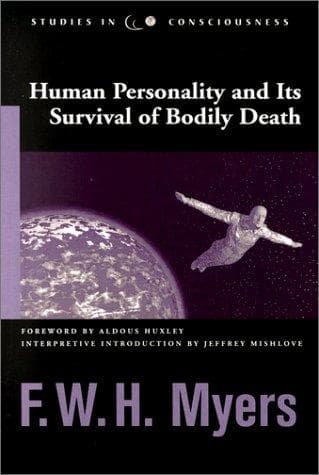
Human Personality and Its Survival of Bodily DeathMyers, F. W. H. (Frederic William Henry)
Religion
Human Personality and Its Survival of Bodily Death
Myers, F. W. H. (Frederic William Henry)
Immortality; Parapsychology; Personality
About four years ago my uncle, Dr. D. J. Parsons, and I were going
to supper, when a man halted us and expressed a desire for medical
advice. My uncle requested him to call the next morning, and as we
walked along he said the case was a bad one and that we would come
back after supper and go to the office and examine the authorities
on the subject. After supper we returned, walked along together on
our way to the office, but just as we reached the door of the drug
store he very unexpectedly, to me, stopped suddenly, which caused
me to stop too; we stood there together a few seconds, and he
remarked to me that he did not feel like going into the office
then, or words to that effect, and told me to go and examine Flint
and Aitken. I went, lit the lamp, and just as I was getting a book,
a pistol was fired into the office, the ball passing close to my
head, struck the east wall, then the north, and fell to the floor.
This 5th day of July, 1891.
JOHN W. PARSONS [Ladonia, Texas.]
In the next group of cases, we reach a class of massive motor impulses
which are almost entirely free from any sensory admixture.
Take for instance the case of Mr. Garrison, who left a religious meeting
in the evening, and walked eighteen miles under the strong impulse to
see his mother, and found her dead. The account is given in the
_Journal_ S.P.R., vol. viii. p. 125 [§ 825].
In another case, that of Major Kobbé (given in _Phantasms of the
Living_, vol. i. p. 288), the percipient was prompted to visit a distant
cemetery, without any conscious reason, and there found his father, who
had, in fact, for certain unexpected reasons, sent to his son, Major
Kobbé, a request (accidentally _not received_) to meet him at that place
and hour.
In a third case, Mr. Skirving (see _Phantasms of the Living_, vol. i. p.
285 [825 A]) was irresistibly compelled to leave his work and go
home--_why_, he knew not--at the moment when his wife was in fact
calling for him in the distress of a serious accident. See also a case
given in _Phantasms of the Living_, vol. ii. p. 377, where a bricklayer
has a sudden impulse to run home, and arrives just in time to save the
life of his little boy, who had set himself on fire.
Public-domain text, read in full here on John Shaqi.
Reviews
Reviews
No reviews yet
Be the first to share your thoughts on this work.
Elsewhere in the archive
Join the Discussion
Join the discussion
Sign in to leave a comment or review.
Sign InorCreate an account