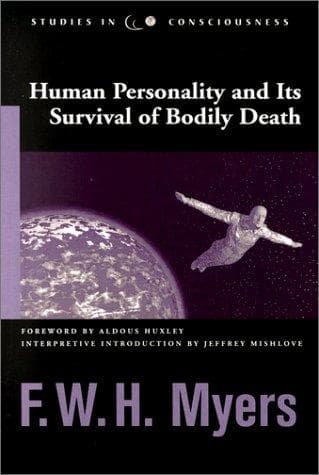
Human Personality and Its Survival of Bodily DeathMyers, F. W. H. (Frederic William Henry)
Religion
Human Personality and Its Survival of Bodily Death
Myers, F. W. H. (Frederic William Henry)
Immortality; Parapsychology; Personality
Now, this is just one of the cases which a less wary observer might have
brought forward as evidence of spirit agency. An identity, it would be
said, manifested itself, and gave an address which none present had ever
heard. But I venture to say that there cannot be any real proof that an
educated person has never heard of Wem. A permanent recorded fact, like
the name of a town which is to be found (for instance) in Bradshaw's
Guide, may at any moment have been presented to Mr. Smith's eye, and
have found a lodgment in his subliminal memory.
Similarly in the answers "Durham" and "Lightfoot" we are reminded of
cases where in a dream we ask a question with vivid curiosity, and are
astonished at the reply; which nevertheless proceeds from _ourselves_ as
undoubtedly as does the inquiry. The prediction in this case was wrong.
What we have been shown is an independent activity of the subliminal
self holding colloquies with the supraliminal, and nothing more. Yet we
shall find, if we go on accumulating instances of the same general type,
that traces of telæsthesia and telepathy begin insensibly to show
themselves; not at first with a distinctness or a persistence sufficient
for actual proof, but just in the same gradual way in which indications
of supernormal faculty stole in amid the disintegration of split
personalities; or in which indications of some clairvoyant outlook stole
in amid the incoherence of dream. Many of these faint indications,
valueless, as I have said, for purely evidential purposes, are
nevertheless of much theoretical interest, as showing how near is the
subliminal self to that region of supernormal knowledge which for the
supraliminal is so definitely closed.[182]
Mr. Schiller's case (see _Proceedings_ S.P.R., vol. iv. pp. 216-224)
[832 A] is a good example of these obscure transitions between normal
and supernormal, and introduces us to several phenomena which we shall
afterwards find recurring again and again in independent quarters.
Dramatisation of fictitious personalities, for instance, which forms so
marked a feature in Professor Flournoy's celebrated case (to be
discussed later), begins in this series of experiments, conducted
throughout with a purely scientific aim, and with no sort of belief in
the imaginary "Irktomar" and the rest. It seems as though this
"objectivation of types" were part of a romance which some inscrutable
but childish humorist was bent on making up. The "cryptomnesia" shown in
this case through the reproduction of scraps of old French with which
the automatist had no conscious acquaintance, reached a point at which
(as again in Professor Flournoy's case) one is almost driven to suspect
that it was aided by some slight clairvoyance on the part of the
subliminal self.
Public-domain text, read in full here on John Shaqi.
Reviews
Reviews
No reviews yet
Be the first to share your thoughts on this work.
Elsewhere in the archive
Join the Discussion
Join the discussion
Sign in to leave a comment or review.
Sign InorCreate an account