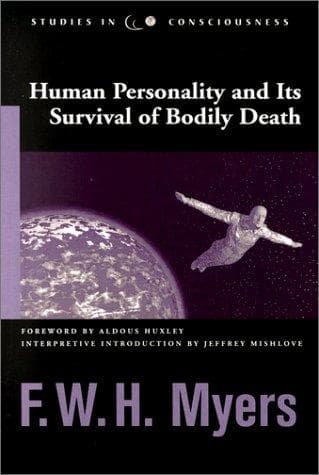
Human Personality and Its Survival of Bodily DeathMyers, F. W. H. (Frederic William Henry)
Religion
Human Personality and Its Survival of Bodily Death
Myers, F. W. H. (Frederic William Henry)
Immortality; Parapsychology; Personality
The operators were placed out of sight of the rest of the company,
who selected--in silence--a photograph, one of an albumful, and
fixed their attention on it. We--the operators--were requested to
keep our minds a blank as far as possible and follow the first
involuntary motion of the Planchette. In three out of five cases it
wrote the name or initial or some word descriptive of the selected
portrait. We also obtained the signatures to letters selected in
the same manner. We both knew perfectly well that _we_ were
writing--not the spirits, as the rest of the company persist to
this day in believing--but had only the slightest idea what the
words might prove to be.
We have tried it since, and generally with some curious result. A
crucial test was offered by two gentlemen in the form of a question
to which we couldn't possibly guess the answer. "Where's Toosey?"
The answer came, "In Vauxhall Road." "Toosey," they explained, was
a pet terrier who had disappeared; suspicion attaching to a plumber
living in the road mentioned, who had been working at the house and
whose departure coincided with Toosey's.
Of course, in the case of the inquiry after the lost dog, we may suppose
that the answer given came from the questioner's own mind. Mrs. Moberly
and her friends seem to have been quite aware of this; and were little
likely to fall into the not uncommon error of asking Planchette, for
instance, what horse will win the Derby, and staking, perhaps, some
pecuniary consideration on the extremely illusory reply.[186]
And now we come to the palmary case of the late Rev. P. H. Newnham,
Vicar of Maker, Devonport, who was personally known to Edmund Gurney and
myself, and was a man in all ways worthy of high respect. The long
series of communications between Mr. Newnham and his wife, which date
back to 1871, and whose contemporaneous written record is preserved in
the archives of the S.P.R., must, I think, always retain their primacy
as early and trustworthy examples of a telepathic transference where the
percipient's automatic script answers questions penned by the agent in
such a position that the percipient could not in any normal manner
discern what those questions were. No part of our evidence seems to me
more worthy of study than this.[187]
Public-domain text, read in full here on John Shaqi.
Reviews
Reviews
No reviews yet
Be the first to share your thoughts on this work.
Elsewhere in the archive
Join the Discussion
Join the discussion
Sign in to leave a comment or review.
Sign InorCreate an account