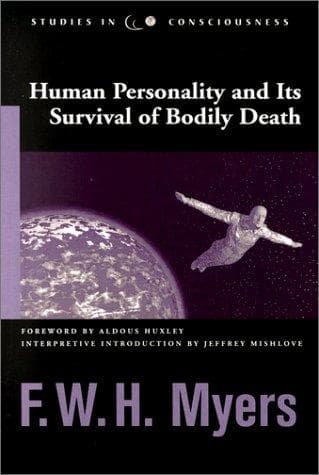
Human Personality and Its Survival of Bodily DeathMyers, F. W. H. (Frederic William Henry)
Religion
Human Personality and Its Survival of Bodily Death
Myers, F. W. H. (Frederic William Henry)
Immortality; Parapsychology; Personality
On this problem, I say, the phenomena of automatic script, of
trance-utterance, of spirit-possession, throw more of light than we
could have ventured to hope.
Stated broadly, our trance-phenomena show us to begin with that several
currents of communication can pass at once from discarnate spirits to a
living man;--and can pass in very varying ways. For clearness' sake I
will put aside for the present all cases where the telepathic impact
takes an externalised or sensory form, and will speak only of
intellectual impressions and motor automatisms.
Now these may pass through all grades of apparent _centrality_. If a
man, awake and in other respects fully self-controlled, feels his hand
impelled to scrawl words on a piece of paper, without consciousness of
motor effort of _his own_, the impulse does not seem to him a _central_
one, although some part of his brain is presumably involved. On the
other hand, a much less conspicuous invasion of his personality may feel
much more central;--as, for instance, a premonition of evil,--an inward
heaviness which he can scarcely define. And so the motor automatism
goes on until it reaches the point of _possession_;--that is to say,
until the man's own consciousness is absolutely in abeyance, and every
part of his body is utilised by the invading spirit or spirits. What
happens in such conditions to the man's ruling principle--to his own
spirit--we must consider presently. But so far as his organism is
concerned, the invasion seems complete: and it indicates a power which
is indeed telepathic in a true sense;--yet not quite in the sense which
we originally attached to the word. We first thought of telepathy as of
a communication between two minds, whereas what we have here looks more
like a communication between a mind and a body,--an external mind, in
place of the mind which is accustomed to rule that particular body.
There is in such a case no apparent communication between the discarnate
mind and the _mind_ of the automatist. Rather there is a kind of contact
between the discarnate mind and the _brain_ of the automatist, in so far
that the discarnate mind, pursuing its own ends, is helped up to a
certain point by the accumulated capacities of the automatist's
brain;--and similarly is hindered by its incapacities.
Yet here the most characteristic element of telepathy, I repeat, seems
to have dropped out altogether. There is no perceptible communion
between the mind of the entranced person and any other mind whatever. He
is _possessed_, but is kept in unconsciousness, and never regains memory
of what his lips have uttered during his trance.
But let us see whether we have thus grasped all the
trance-phenomena;--whether something else may not be going on, which is
more truly, more centrally telepathic.
Public-domain text, read in full here on John Shaqi.
Reviews
Reviews
No reviews yet
Be the first to share your thoughts on this work.
Elsewhere in the archive
Join the Discussion
Join the discussion
Sign in to leave a comment or review.
Sign InorCreate an account