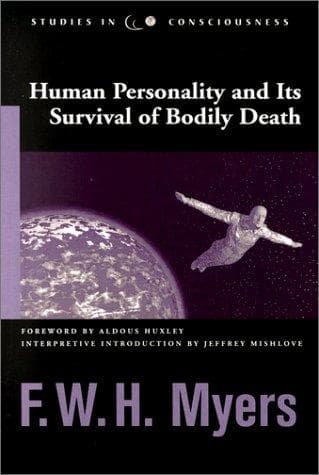
Human Personality and Its Survival of Bodily DeathMyers, F. W. H. (Frederic William Henry)
Religion
Human Personality and Its Survival of Bodily Death
Myers, F. W. H. (Frederic William Henry)
Immortality; Parapsychology; Personality
Here are three cases [the one just given, that of another patient
of his own, and that of Félida X.] in which a second
personality--perfectly sane, thoroughly practical, and perfectly in
touch and harmony with its surroundings--came to the surface, so to
speak, and assumed absolute control of the physical organisation
for long periods of time together. During the stay of the second
personality the primary or original self was entirely blotted out,
and the time so occupied was a blank. In neither of the cases
described had the primary self any knowledge of the second
personality, except from the report of others or letters from the
second self, left where they could be found on the return of the
primary self to consciousness. The second personality, on the other
hand, in each case, knew of the primary self, but only as another
person--never as forming a part of, or in any way belonging to
their own personalities. In the case of both Félida X. and Alma Z.,
there was always immediate and marked improvement in the physical
condition when the second personality made its appearance.
The case of Mollie Fancher,[24] which, had it been observed and recorded
with scientific accuracy, might have been one of the most instructive of
all, seems to stand midway between the transformations of Louis
Vivé--each of them frankly himself at a different epoch of life--and the
"pseudo-possessions" of imaginary spirits with which we shall in a later
chapter have to deal.
The case of Anna Winsor[25] goes so far further in its suggestion of
interference from without that it presents to us, at any rate, a
contrast and even conflict between positive insanity on the part of the
organism generally with wise and watchful sanity on the part of a single
limb, with which that organism professes to have no longer any concern.
The last case[26] that I shall mention is that of Miss Mary Lurancy
Vennum, the "Watseka Wonder."
The case briefly is one of alleged "possession," or "spirit-control."
The subject of the account, a girl nearly fourteen years old, living at
Watseka, Illinois, became apparently controlled by the spirit of Mary
Roff, a neighbour's daughter, who had died at the age of eighteen years
and nine months, when Lurancy Vennum was a child of about fifteen months
old. The most extraordinary feature in the case was that the control by
Mary Roff lasted almost continuously for a period of four months.
For the present we must consider this case as a duplication of
personality--a pseudo-possession, if you will--determined in a
hysterical child by the suggestion of friends, but at a later stage, and
when some other wonders have become more familiar than now, we may find
that this singular narrative has further lessons to teach us.
Public-domain text, read in full here on John Shaqi.
Reviews
Reviews
No reviews yet
Be the first to share your thoughts on this work.
Elsewhere in the archive
Join the Discussion
Join the discussion
Sign in to leave a comment or review.
Sign InorCreate an account