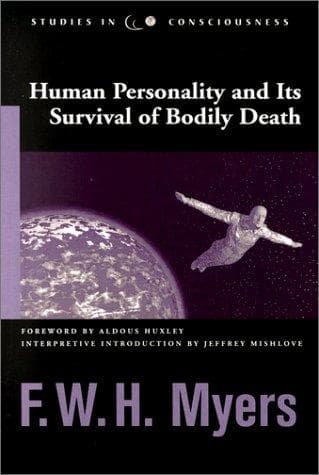
Human Personality and Its Survival of Bodily DeathMyers, F. W. H. (Frederic William Henry)
Religion
Human Personality and Its Survival of Bodily Death
Myers, F. W. H. (Frederic William Henry)
Immortality; Parapsychology; Personality
We have now briefly surveyed a series of disintegrations of personality
ranging from the most trifling _idée fixe_ to actual alternations or
permanent changes of the whole type of character. All these form a kind
of continuous series, and illustrate the structure of the personality in
concordant ways. There do exist, it must be added, other forms of
modified personality with which I shall not at present deal. Those are
cases where some telepathic influence from outside has been at work, so
that there is not merely dissociation of existing elements, but apparent
introduction of a novel element. Such cases also pass through a long
series, from small phenomena of motor automatism up to trance and
so-called possession. But all this group I mention here merely in order
to defer their discussion to later chapters.
The brief review already made will suffice to indicate the complex and
separable nature of the elements of human personality. Of course a far
fuller list might have been given; many phenomena of actual insanity
would need to be cited in any complete conspectus. But hysteria is in
some ways a better dissecting agent than any other where delicate
psychical dissociations are concerned. Just as the microscopist stains a
particular tissue for observation, so does hysteria stain with
definiteness, as it were, particular synergies--definite complexes of
thought and action--more manifestly than any grosser lesion, any more
profound or persistent injury could do. Hysterical mutism, for instance
(the observation is Charcot's[27]), supplies almost the only cases where
the faculty of vocal utterance is attacked in a quite isolated way. In
aphasia dependent upon organic injury we generally find other
word-memories attacked also,--elements of agraphy, of word-blindness, of
word-deafness appear. In the hysteric the incapacity to speak may be the
single symptom. So with anæsthesiæ; we find in hysteria a separation of
sensibility to heat and to pain, possibly even a separate subsistence of
electrical sensibility. It is worth remarking here that it was during
the hypnotic trance, which in delicacy of discriminating power resembles
hysteria, that (so far as I can make out) the distinctness of the
temperature-sense from the pain-sense was first observed. Esdaile, when
removing tumours under mesmerism in Calcutta, noticed that patients, who
were actually undergoing capital operations without a murmur, complained
if a draught blew in upon them from an open window.
Public-domain text, read in full here on John Shaqi.
Reviews
Reviews
No reviews yet
Be the first to share your thoughts on this work.
Elsewhere in the archive
Join the Discussion
Join the discussion
Sign in to leave a comment or review.
Sign InorCreate an account