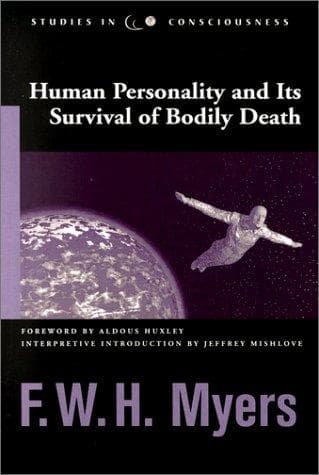
Human Personality and Its Survival of Bodily DeathMyers, F. W. H. (Frederic William Henry)
Religion
Human Personality and Its Survival of Bodily Death
Myers, F. W. H. (Frederic William Henry)
Immortality; Parapsychology; Personality
I think that an intelligent study of visual and motor automatism will
afford us sufficient proof that symbolism, at any rate pictorial
symbolism, becomes increasingly important as we get at the contents of
those hidden strata. Telepathic messages, especially, which form, as we
shall see, the special prerogative or characteristic of subliminal
communication, seem to be conveyed by vague impression or by inward or
externalised picture oftener than by articulate speech. And I may so far
anticipate later discussion of _automatic writings_ (whether
self-inspired or telepathic) as to point out a curious linguistic
quality which almost all such writings share. The "messages" of a number
of automatists, taken at random, will be sure to resemble each other
much more closely than do the supraliminal writings of the same persons.
Quite apart from their general correspondence in _ideas_--which belongs
to another branch of our subject--there is among the automatic writings
of quite independent automatists a remarkable correspondence of literary
style. There is a certain quality which reminds one of a _translation_,
or of the compositions of a person writing in a language which he is not
accustomed to talk. These characteristics appear at once in automatic
script, even of the incoherent kind; they persist when there is no
longer any dream-like incoherence; they are equally marked, even when,
as often happens, the automatic script surpasses in intelligence, and
even in its own kind of eloquence, the products of the waking or
supraliminal mind.
And side by side and intercurrent with these written messages come those
strange meaningless arabesques which have been baptized as
"spirit-drawings"--though they rarely show any clear trace of the
operation of an external intelligence.[35] These complex and fanciful
compositions--often absolutely automatic--appear to me like a stammering
or rudimentary symbolism; as though the subliminal intelligence were
striving to express itself through a vehicle perhaps more congenial to
its habits than articulate language.
Returning, then, from these illustrations drawn from actual _automatism_
to our proper subject of _genius_,--that happy mixture of subliminal
with supraliminal faculty,--we may ask ourselves in what kind of
subliminal uprush this hidden habit of wider symbolism, of
self-communion beyond the limits of speech, will be likely to manifest
itself above the conscious threshold.
Public-domain text, read in full here on John Shaqi.
Reviews
Reviews
No reviews yet
Be the first to share your thoughts on this work.
Elsewhere in the archive
Join the Discussion
Join the discussion
Sign in to leave a comment or review.
Sign InorCreate an account