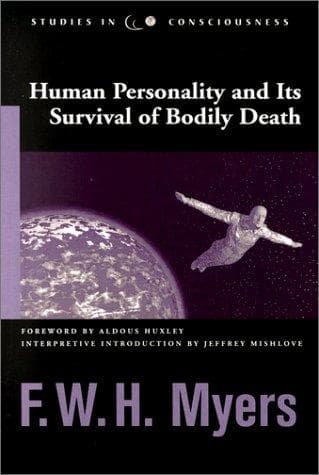
Human Personality and Its Survival of Bodily DeathMyers, F. W. H. (Frederic William Henry)
Religion
Human Personality and Its Survival of Bodily Death
Myers, F. W. H. (Frederic William Henry)
Immortality; Parapsychology; Personality
But when we reach this point we have begun (as I say) to transcend the
special province to which, in Chapter I, I assigned the title of
_genius_. I there pointed out that the influence of the subliminal on
the supraliminal might conveniently be divided under three main heads.
When the subliminal mentation co-operates with and supplements the
supraliminal, without changing the apparent phase of personality, we
have _genius_. When subliminal operations change the apparent phase of
personality from the state of waking in the direction of trance, we have
_hypnotism_. When the subliminal mentation forces itself up through the
supraliminal, without amalgamation, as in crystal-vision, automatic
writing, etc., we have _sensory or motor automatism_. In accordance with
this definition, the _content_ of the inspirations of genius is supposed
to be of the same general type as the content of ordinary thought. We
have regarded genius as crystallising fluid ideas; or, if you will, as
concentrating and throwing upwards in its clear fountain a maze of
subterranean streams. But we have not regarded it as modifying, in such
operation, the ordinary alert wakefulness of the thinker, nor as
providing bun with any fresh knowledge, obtainable by supernormal
methods alone.
It is plain, however, that such distinctions as those which I have drawn
between genius, trance, automatism, cannot possibly be rigid or
absolute. They are distinctions made for convenience between different
phases of what must really be a continuous process--namely, the
influence of the Self below the threshold upon the Self above it.
Between each of these definite phases all kinds of connections and
intermediate stages must surely exist.
Connections between _trance_ and _automatism_, indeed, are obvious
enough. The difficulty has rather lain in their clear separation.
Trance, when habitual, is pretty sure to lead to automatic speech or
writing. Automatism, when prolonged, is similarly apt to induce a state
of trance.
The links between _Genius_ and these cognate states are of a less
conspicuous kind. They do, however, exist in such variety as to confirm
in marked fashion the analogies suggested above.
And first, as to the connection between genius and automatism, one may
say that just as anger is a brief madness, so the flash of Genius is
essentially a brief automatism.
Wordsworth's moments of inspiration, when, as he says,
"Some lovely image in the song rose up
Full-formed, like Venus rising from the sea,"
were in effect moments of automatic utterance; albeit of utterance held
fast in immediate co-operation with the simultaneous workings of the
supraliminal self. Such a sudden poetic creation, like the calculating
boy's announcement of the product of two numbers, resembles the sudden
rush of planchette or pencil, in haste to scrawl some long-wished-for
word.
Public-domain text, read in full here on John Shaqi.
Reviews
Reviews
No reviews yet
Be the first to share your thoughts on this work.
Elsewhere in the archive
Join the Discussion
Join the discussion
Sign in to leave a comment or review.
Sign InorCreate an account