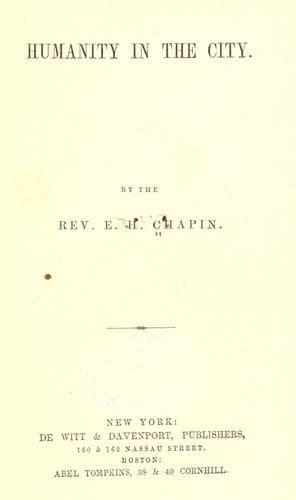
Sermons, American; Universalist Church of America -- Sermons
And results as bad as this appear in the conditions of poverty,
suffering, and social degradation. Every fine chord of human nature is
seared, sodden, torn from its sockets, in the darkness of the moral
faculties and by the pressure of animal wants. The poor man is conscious
of nothing but privation and suffering. He gazes at the power and
discipline and pomp of society all about him, not as an ally but as a
captive, or as a savage foe. The whole wears the aspect of a besieging
army, and the Ishmaelitish feeling predominates. In the midst of the
City he becomes an Arab of the desert, a robber of the rock. Now, it
makes little difference whether the circle is wider or narrower, whether
the siege is a moral or a literal one, whether the agent is the sword or
the condition of society. The essential results will be the same. The
civilization of New York may and does hem in a desolation as fearful in
kind as that of Jerusalem, and involves sufferings as keen, and wakes
up instincts as fiercely selfish. And one whose sympathies with the wide
humanity are as fresh and clear as the Prophet's were with the woes of
his people, might draw closer within these various circles of prosperity
and refinement and activity, that lend such attractiveness to the great
city--this magnificent girdle of commerce, embossed with the symbols of
all nations--these arteries of traffic, filled with circulating wealth
and power--these groups of fashion and of beauty, whose cheapest jewels
would open the kingdom of heaven to ten thousand souls; he might pass
within all these bands of "civilization," and in some alley, or "Five
Points," sit down and weep for the calamity of his brethren. He would
behold there War and Captivity enough to fill an entire volume of
Lamentations. Captivity! were men ever bound by a darker chain, or
trampled by a harder heel, than those victims of destitution and of
their own passions? War! did the Jew behold any hosts more terrible
pressing into Jerusalem, than you and I might see if we looked about us?
The entrenched filth that all day long sends its steaming rot through
lane and dwelling, through bone and marrow, and saps away the life. Cold
that encamps itself in the empty fire-place, and blows through the
broken door, and paralyzes the naked limbs. Hunger that takes the strong
man by the throat, and kills the infant in its mother's arms. And still
another traitorous legion that, equipped with the fascinations of the
bottle and the shamelessness of harlotry, appeals to the passions of the
brutal and proffers comfort to the hearts of the sad. War and Captivity
in the midst of peace and refinement--is it not, my friends? And, with
all this, may we not expect that fierce instinct of selfishness which
overwhelms every other impulse, and breaks out in crime? Ah! and do we
not discover a counterpart to that saddest feature of all in such
circumstances--a desecration even of the parental instinct? Fathers,
Public-domain text, read in full here on John Shaqi.
Reviews
Reviews
No reviews yet
Be the first to share your thoughts on this work.
Elsewhere in the archive
Join the Discussion
Join the discussion
Sign in to leave a comment or review.
Sign InorCreate an account