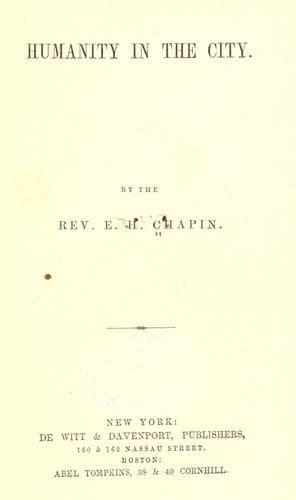
Sermons, American; Universalist Church of America -- Sermons
But our purpose this evening calls us away from these brighter images of
childhood, to consider those who are surrounded with the most savage
aspects and the worst influences of the world. And, beside the absolute
duty which is imposed upon us by their natural position, I observe that
the Children of the Poor create an appeal to _prudential_
considerations. They form a large proportion of those groups known in
every city as "The _Dangerous_ Classes." For they will be developed
somehow. If they receive not that attention which is demanded by their
position; if they are left to darkness and neglect; still, it is no mere
mass of negative existence that they constitute. There is vitality there
and positive strength, in those lanes and cellars, put forth for evil if
not drawn towards the good. We must not confound ignorance with torpor
of spirit or bluntness of understanding. One of the most remarkable
characteristics of vagrant children is a keen, precocious intellect. A
boy of seven in the streets of a city is more developed in this respect
than one of fourteen in the country--a development, of course, which is
easily accounted for by the antagonisms with which the child has had to
contend, and the devices which have been inspired by the sheer pressure
of want. He has been pitched into the sea of events to sink or swim, and
those sharpened faculties are the tentacles put forth by an effort of
nature in order to secure a hold of life. And there is something very
sad and very fearful in this precocity. The vagrant boy has known
nothing of the stages of childhood, conducting with beautiful simplicity
from one timid step to another, and gradually forming it for the
realities of the world. But the neglected infant has wilted into the
premature man, with his old cunning look, blending so fantastically, so
mournfully, with the unformed features of youth. Knowing the world on
its worst side--knowing its hostility, its knavery, its foulness, its
heartless materialism--knowing it as the man does not know it who has
only breathed the country air, and looked upon the open face of nature.
Is it not very sad, my friends, that the vagrant boy _should_ know so
much; and, without one hour of romance, one step of childish innocence
and imagination, should have gone clear through "the world" which so
many boast that they understand--the knave's world, the libertine's
world, the world of the skeptical, scoffing, Ishmaelitish spirit? And
yet he has so little _real_ knowledge--there is such a cloud of
ignorance and moral stupor resting upon his brain and heart! So much of
him is merely animal, foxy, wolfish, and this sharpened intellect only a
faculty, an instinct, a preternatural organ pushed out to gain
subsistence with. It is a terrible anomaly, and yet, I say, it is none
the less an active power, and shows us that, however neglected, the
child of the abject poor is not dormant or undeveloped. In the first
Public-domain text, read in full here on John Shaqi.
Reviews
Reviews
No reviews yet
Be the first to share your thoughts on this work.
Elsewhere in the archive
Join the Discussion
Join the discussion
Sign in to leave a comment or review.
Sign InorCreate an account