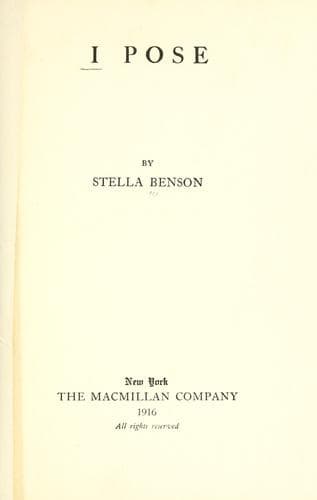
London (England) -- Fiction; Satire; Suffragists -- Fiction
With excellent intentions the suffragette had, I think, succeeded in
killing her heart. She was so heartless that even the hole where her
heart should have been was a very shallow one. Some rudimentary emotion
turned in her breast as she walked up the drive, and if she could have
had the gardener as a friend, she would have turned even then and
tendered him the friendly mailed fist of the independent woman. But if
one is a fanatic, one cannot also be a lover. She suffered from the cold
humility that sometimes attacks women. Every morning she occupied three
minutes in the thankless task of pinning her hair into a shape
conformable with convention’s barest requirements, and was then
confronted with her own thin short face, white—but not white like a
flower as the face of a beloved woman should be; her small eyes,
grey—but not grey like the sea; her straight and drooping hair, made out
of the ashes of the flame that burns in real women’s hair; her thin
pressed lips, her hard set chin, the little defiant wrinkles over her
brows.... It was impossible for her to believe that such a thing could
be indispensable to any eyes. Her attitude towards the paradox was
always sceptical, and the idea that there is nothing a woman can offer
as a substitute for such a small gift as herself was beyond her. The
little ordinary fiery things of youth had been shorn out of her life,
she had been crushed by the responsibility of being a woman and a
devotee.
No man would believe that such a woman exists. The pathetic vanity of
man would never be convinced that any woman could prefer her own
independence to his kisses.
By the time the suffragette had reached the front door of Park View, the
interview with the gardener was but a pulse beating at the back of her
mind.
Miss Brown, looking as nearly dishevelled as a persistently Real Lady
could possibly look, was standing in the hall, ankle-deep in her own
prostrate property. Trunks yawned on every side, highly respectable
dresses, like limp ghosts of Miss Brown herself, embellished every
chair.
“And I haven’t even begun on Albert’s books yet.”
“The more of Albert’s books we leave behind the better,” replied the
suffragette. “I have got him _Treasure Island_ to read on the boat, and
he might take that one on Chemistry for Sundays.”
“I’m sure I don’t know how you manage Albert,” said Miss Brown. “I could
never even get him to read the Bible. It really looks as if Providence
had sent you to us at this crisis.”
“Providence would never have chosen a militant suffragette.”
“Well, but really one wouldn’t notice your opinions,” said Miss Brown in
an encouraging voice.
“What about Scottie?” asked the suffragette. “Has anybody thought what
is going to happen to him?”
“I haven’t thought of any details,” answered Miss Brown. “The doctor’s
orders were so sudden, they altogether upset me. I suppose Scottie can
be left with John.”
Public-domain text, read in full here on John Shaqi.
Reviews
Reviews
No reviews yet
Be the first to share your thoughts on this work.
Elsewhere in the archive
Join the Discussion
Join the discussion
Sign in to leave a comment or review.
Sign InorCreate an account