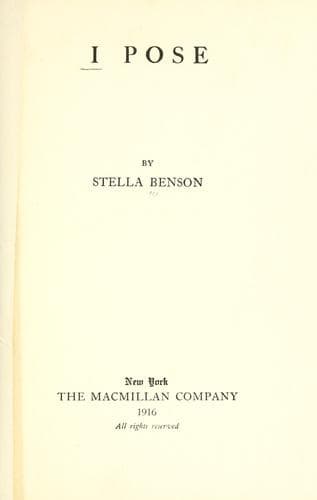
London (England) -- Fiction; Satire; Suffragists -- Fiction
“I think all women ought to marry,” said Mr. Wise. “Somehow it keeps
them softer.”
“It wouldn’t make a hard woman soft,” said Courtesy. “Only all the soft
women do marry.”
“Do you consider——”
“Ou, Lor’, this is a killing conversation!” interrupted the lady. “Let’s
talk about something else.”
“All right. That’s a very pretty dress you’ve got on.”
They found the gardener sitting on tenterhooks on the verandah, pulling
Scottie’s ears.
“What did she say?”
“She didn’t. She’s gone to London.”
“I hope they’ll take care of Westminster Abbey,” said Mrs. Rust.
The gardener said nothing.
By this time the suffragette was putting romance behind her by means of
a little boat limping across a heavy sea. Compared to the _Caribbeania_,
this boat was like my suffragette compared with Mr. Shakespeare’s
Desdemona. There was rust on the little boat’s metal, and her paint
still bore memories of London smuts. The purser was occasionally to be
seen in his shirt sleeves, and the Captain had a button off his coat.
The priest was on board, returning to his flock, overflowing with
material for sermons. By mutual consent he and the suffragette ignored
each other. He made an attempt to approach Albert, with his special
children’s manner, but that cultured youth quickly silenced him. So he
occupied himself in trying to save the soul of the second officer, a
docile youth, of humble and virtuous tendency.
Within two days the little boat reached the Isthmus which has lately
been converted into one of the wonders of the world.
“My poor Albert,” said the suffragette. “I’m afraid the doctor says you
mustn’t go to see the Canal. It’s so dusty. And you know such a lot
about it, don’t you? It is disappointing.”
“I dow quite edough about it,” replied Albert. “I have do wish whatever
to see it. I dow every detail of its codstructiod.”
“That’s all right, then. The doctor says when it’s cool after dark, you
may walk as far as the gardens behind the quay, and listen to the band.”
“I do dot wish to hear the badd. I wish you ad Ah-Bargaret to go away
for the whole day, ad let the youggest stewardess cob ad sit with be.
She is a charbig persod, ad it would be very good for you to see the
Cadal.”
In Albert’s eyes the halo of the suffragette was to some extent
evaporating. Her attitude towards science alienated him in his capacity
as an educated man, although as a child in pain he still clung to her.
And she had that morning offended him by buying him a bottle of sweets
from the barber’s shop.
“I really thigk you sobetibes forget I ab do logger a baby,” he
observed, and forthwith began to lay great stress on the charm of the
youngest stewardess.
Miss Brown was delighted at the fall of her nephew’s latest idol.
“You’d better come away,” she said. “Let’s go and see the Canal. If you
stay with Albert when he is displeased, you get on his nerves.”
Public-domain text, read in full here on John Shaqi.
Reviews
Reviews
No reviews yet
Be the first to share your thoughts on this work.
Elsewhere in the archive
Join the Discussion
Join the discussion
Sign in to leave a comment or review.
Sign InorCreate an account