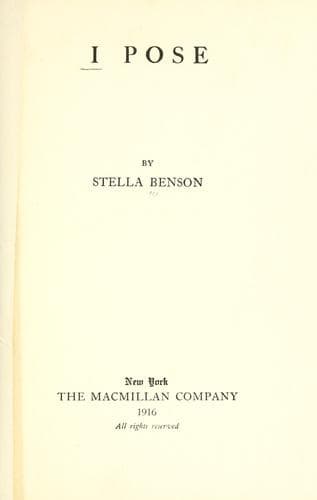
London (England) -- Fiction; Satire; Suffragists -- Fiction
In this wonderful age we do our disappearing by machinery. Fairy
godmothers prefer Rolls-Royce cars to broomsticks, the pirate employs a
submarine instead of a gallant three-decker, the black sheep of the
piece, instead of donning a mask and confining the rest of his career to
Maidenhead Thicket, books his passage to a Transatlantic sheepfold on a
thirty-knot liner.
The suffragette disappeared by the London train. By travelling third,
she hoped to escape the majority of her fellow-passengers, and it was
not until the train began to leave the station that she identified a
hitherto unnoticed person opposite to her as the priest.
The priest was always overcome by a feeling of virtue when he travelled
third.
“So our modesty is mutual,” he said jovially to the suffragette. “Yerce,
yerce, in England I travel third on principle. My parish, you know, is
in a poor part of London, and I think a shepherd should as far as
possible share the circumstances of his flock.”
The suffragette hovered for a moment over a very crude flower of
repartee dealing with cattle-trucks, but discarded the idea. She was
always cautious, when she allowed herself time for caution. Her
principle in conversation was, “When in doubt—don’t.” But being a
militant suffragette, she was seldom in doubt.
The priest was aggrieved with the suffragette, partly because he felt
obliged to speak to her. He would have preferred to ignore her, but she
had behaved too well during the last few days. She had tried as hard to
save a life as ever he had tried to save a soul, and had failed with
equal dignity. Inconsistency annoyed him very much. You must be one of
two things, a sheep or a goat, preferably the latter until the priest
himself had had time to lead you to the fold. For a confessed goat
suddenly to don wool without any help from him looked very much like
deliberate prevarication. He did not now know how to classify the
suffragette, and not knowing how to do a thing in which he had
specialised was naturally exasperating.
“You were asking for my advice about the problem of your future,” he
said, leaning confidentially towards her. “I have been thinking much
about you, and I believe I have solved the problem.”
I need hardly say that the suffragette never asked for advice. When
circumstances obliged her to follow the advisable course, she hid her
docility like a sin.
“My future always looks after itself, thank you,” she said in a polite
voice, “and so does my past. It’s old enough.”
The priest stiffened for a moment, but when on the track of a goat he
was hard to check. Besides, the suffragette’s voice was so low and calm
that her words seemed like a mistake, not to be taken seriously.
Public-domain text, read in full here on John Shaqi.
Reviews
Reviews
No reviews yet
Be the first to share your thoughts on this work.
Elsewhere in the archive
Join the Discussion
Join the discussion
Sign in to leave a comment or review.
Sign InorCreate an account