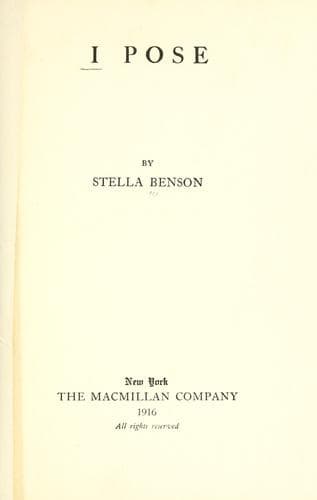
London (England) -- Fiction; Satire; Suffragists -- Fiction
The suffragette kept a lonely flat not far from Covent Garden,
apparently with the object of ensuring herself the right to exercise a
vote when she should have procured that luxury. For she very seldom put
the flat to the ordinary uses of flats. It contained a table and two
chairs, as a provision against the unlikely event of its owner’s
succumbing to social weaknesses. It also contained a bed. Curtains and
carpets, and any cooking arrangement more elaborate than a gas-ring, are
not included in the Theory of the Hair Shirt, the motto of which is, “I
can very well do without.”
The suffragette deposited the mustard-coloured portmanteau at this
Spartan abode, and went to report herself to her Society. She was not a
famous suffragette. If I told you her name, you would not raise your
eyebrows and laugh facetiously and say, “Oh—_that_ maniac....” She was
nominally one of the rank and file, although, being rebellious even
against co-rebels, she seldom acted under orders.
There are, broadly speaking, two kinds of workers in the world, the
people who do all the work, and the people who think they do all the
work. The latter class is generally the busiest, the former never has
time to be busy.
The Chief Militant Suffragette, who believed that she held feminism in
the hollow of her hand, was a born leader of women. She was familiar
with the knack of wringing sacrifices from other people. She was a
little lady in a minor key, pale and plaintive, with short hair, like
spun sand. She dressed as nearly as possible like a man, and affected an
eyeglass. She probably thought that in doing this she sacrificed enough
for the cause of women. She had safely found a husband before she cut
her hair. I suppose she had sent more women to prison than any one
magistrate in London, but she had never been to prison herself.
The cause of the Suffrage, while attracting the finest women in the
country, also attracts those who consider themselves to be the finest.
It has an equal fascination for those who can work but can never lead
and for those who can lead but never work.
“I have written to you three times,” said the Chief M.S. pathetically to
the suffragette. “I do think you might have answered.”
“So do I,” admitted the suffragette, “only that I have been abroad. What
did you write to me about?”
“Abroad?” said the Chief M.S., and raised her eyebrows. She had none
really, but she raised the place where they should have been. “Abroad?
Enjoying yourself at such a time as this?”
“What do you mean?” asked the suffragette. “What has happened? Have we
got the Vote?”
The eyeglass of the Chief M.S. fell out with annoyance. “Of course not,”
she said, “but it’s the great massed procession and deputation
to-morrow, and I wanted you to help with the North London section.”
Public-domain text, read in full here on John Shaqi.
Reviews
Reviews
No reviews yet
Be the first to share your thoughts on this work.
Elsewhere in the archive
Join the Discussion
Join the discussion
Sign in to leave a comment or review.
Sign InorCreate an account