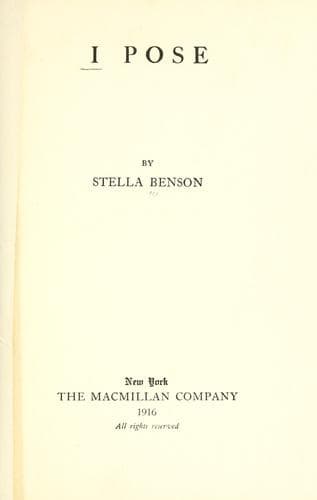
London (England) -- Fiction; Satire; Suffragists -- Fiction
You will perhaps not be surprised to learn that never once in her life
had her leisure meant some one else’s pleasure. There had never been any
one who would have been in the least interested to know that the
suffragette had a few hours unbooked. She never regretted this fact,
because she never noticed it. With the exception of Excursion Agents, I
should think no one ever knew the holiday resorts around London better
than she did. She could enjoy herself very much indeed sitting seriously
on grass, watching a world dotted with sentimental cockneyism. It gave
her no pang to be one among many twos.
To-day she found the seat that sits forever looking at the place where
the snowdrops should be, and only really lives when they come out. And
when she got there, it was most annoying, she thought of the gardener,
to the exclusion of everything else. After several minutes she found
that she had been occupied in committing the address she had been given
to memory.
“Number Twenty-one Penny Street. Twenty-one Penny Street.”
I cannot account for the occasional inconsistency of this woman except
by reminding you of a certain well-known natural phenomenon. Just as a
man whose arm has been amputated may still suffer from a phantom
finger-ache, so a woman who has killed her heart must, at certain points
in her life, feel the pain of a heart, as if the dead thing turned in
its grave. One of the most tragic things about loss is that it is never
annihilation.
“This is absurd,” thought the suffragette, pulling herself together. “I
must make a plan of campaign, as the M.S. Society would say. How am I
going to start?”
Brown Borough popularity is a slippery thing to seize. You must have a
handle to grasp it by.
A robin appeared, like a fairy, between two snowdrops. He did not notice
the suffragette, nevertheless he looked self-conscious. He re-arranged a
perfectly neat feather, and glanced at his waistcoat to see whether its
curve was correct. He even tried to glance over his waistcoat at his
feet, but this was physically impossible. The suffragette loved him
until she realised that he was in love, on which she wearied of him. A
chirrup behind her drew her attention to the lady in the case.
“I believe I’ll have to get hold of the priest,” said the suffragette. I
have told you that she was devoid of tact. She never took enough notice
of the world to sulk when the world was unkind, she was not human enough
to quarrel. I have seen her give great offence to the Chief M.S. by
borrowing a cigarette in the middle of a tempestuous scene of mutual
reproach. She never reviewed the past when arranging for the future, and
this, in human relations, is a fatal mistake.
Public-domain text, read in full here on John Shaqi.
Reviews
Reviews
No reviews yet
Be the first to share your thoughts on this work.
Elsewhere in the archive
Join the Discussion
Join the discussion
Sign in to leave a comment or review.
Sign InorCreate an account