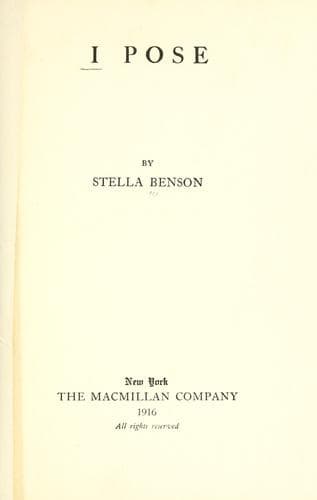
London (England) -- Fiction; Satire; Suffragists -- Fiction
The suffragette shut in a renewed protest with a snap of her jaws.
Although she badly needed a handle by which to seize the Brown Borough,
surely there must be other handles than the Church. She determined
secretly on determination as her unaided weapon.
But she went to see the Wigskys. She found them—a large family, red and
mutually wrathful in an atmosphere of hot smells ancient and modern.
When she got inside the door she wondered why she had come. The baby
screaming on its mother’s breast looked incorrigibly heathen, the eldest
girl looked wholly unsuited to any “excellent place” discovered by the
priest.
“Wooder _you_ want?” asked the harassed mother, a drab and dusty
creature, with the used look of cold ashes.
“I’ve come from Father Christopher ...” began the suffragette, wishing
she had come from some one else.
“’N you can go back to Farver Christopher,” said Mrs. Wigsky. “Becos I
ain’t goin’ to ’ave no more bibies christened. It’s ’eaven ’ere, an’
’eaven there, this biby’s goin’ ter grow up ’eeven fer a chinge. It
carn’t get us into worse trouble nor wot we’ve ’ad.”
“I haven’t come to bother you,” said the suffragette. “After all, it’s
your baby, not Father Christopher’s.”
“That’s wot I ses,” said the mother, slightly mollified. “Well, if you
’aven’t come abaht Biby, wot ’ave you come for?”
“I’ve come because I want to find friends in the Brown Borough. If you
don’t want me, please tell me to go.”
The Brown Borough never protests if you surprise it; and in any case,
Mrs. Wigsky’s soul was too dead for consistent protest. Also it was
certainly a change to be visited by one who lacked the visitor’s
apprising eye, who seemed unaware of an unswept floor and an unmade bed.
“As Father Christopher talked about the Brown Borough women ...” said
the suffragette, “I wanted more and more to know them, because it seems
to me so splendid to keep going at all in the Brown Borough. I must tell
you I always love women. So you must forgive me for coming.”
“’Tain’t often as lidies come to admire us,” said Mrs. Wigsky. “They
allus comes to show us ’ow wrong we are.”
“I’m not a lady,” said the suffragette.
“Ow, yus you are,” said the eldest girl, speaking for the first time.
“Are you the girl that’s out of a job?” asked the suffragette.
“Yus. Farver Christopher got me a job as general to the lidy oo keeps
the post orfice. She give me three-an’-six a week an’ no food, an’
mother ain’t earnin’ now, an’ Tom’s in ’orsbital, so it weren’t good
enough. I run awiy. She ’it me too, an’ mide me cerry up the coals. But
’er bein’ a lidy, I couldn’t siy much—I jus’ run awiy.”
“I wish you’d hit her back,” said the suffragette. “And I wish the word
‘lady’ had never been invented.”
“Lidies is lidies, an’ generals is generals,” said Mrs. Wigsky. “Gawd
mide it so, an’ you carn’t get over it.”
Public-domain text, read in full here on John Shaqi.
Reviews
Reviews
No reviews yet
Be the first to share your thoughts on this work.
Elsewhere in the archive
Join the Discussion
Join the discussion
Sign in to leave a comment or review.
Sign InorCreate an account