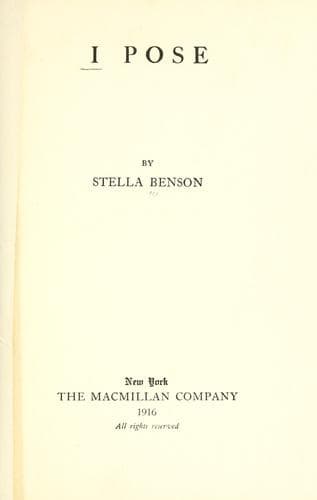
London (England) -- Fiction; Satire; Suffragists -- Fiction
The cottage hospital had only recruited to the service of the sick in
later life. For a hundred years or so it had been the haunt of the
wicked landowner. Worldly squires’ wives had given tea in its paved
pergola to curates’ wives in their best hats. But as the house grew
older it reformed. Its walls, steeped in the purple village gossip of a
century, now echoed only to the innocent if technical prattle of nurses.
The only person who walked in its garden was Sister: she threw crumbs to
the goldfish as severely as though the crumbs were for their good. For
the blessing which the house inherited from its past was its garden. A
small garden, like a cut emerald, but reflecting all other jewels. It
was a garden that tried to enshrine sombre peace amid the vivid riot of
spring. Its high clipped hedges drew decorously angular reflections in
the pools. Brown wallflowers hid the feet of the hedges. The lilacs
seemed somehow turned to half mourning by the proximity of a copper
beech. A veil of tree seeds spinning down the wind fell diagonally
across the garden. The pink horse chestnut was very symmetrical. Only
the little saxifrages protested against the geometrical correctness of
the paving-stones, and forget-me-nots sang a shrill song in blue from
the restraining chaperonage of red pottery tubs. A little cupid with a
dislocated hip played a noiseless flute from a pedestal. The garden was
a prig, but it was the sort of prig that makes you wonder whether after
all it is worth while to be so exquisitely sinful.
They found Samuel Rust, who was the only patient in the hospital, the
centre of a mist of nurses. He was lying in the shade of a great smooth
yew pyramid with a military-looking bird fashioned on the top of it.
Samuel Rust, that unusual young man, could never be much paler than he
had been when in health, but he was grey now, rather than white, and his
round sequins of eyes were set in a deeper setting.
“The Tra-la-la young man,” he said as the gardener approached. “I have
been wondering why I wanted to see you.”
“So have I,” said Mrs. Rust, who, after a momentary lapse into a
maternal expression, had turned her back on the invalid.
“Let’s pretend I’m just an ordinary sick-bed visitor, then,” suggested
the gardener. “One never knows why—or whether—one wants to see that sort
of visitor. In that case I have to begin:—Dear Mr. Rust, I hope you are
much better.”
“Still posing,” said Samuel. “What is your latest attitude?”
“I never pose,” said the gardener. “I have a horror of the pose. My
mind’s eye sometimes changes the spectacles it wears, but that’s all. I
now find that all along the gods were intending me to be a business
man.”
“Hard luck,” said Samuel.
The nurses had melted away, and Mrs. Rust followed them into the house.
The sun was making ready for his triumph in the west and a diffident
moon perched on the peak of the pink horse chestnut.
Public-domain text, read in full here on John Shaqi.
Reviews
Reviews
No reviews yet
Be the first to share your thoughts on this work.
Elsewhere in the archive
Join the Discussion
Join the discussion
Sign in to leave a comment or review.
Sign InorCreate an account