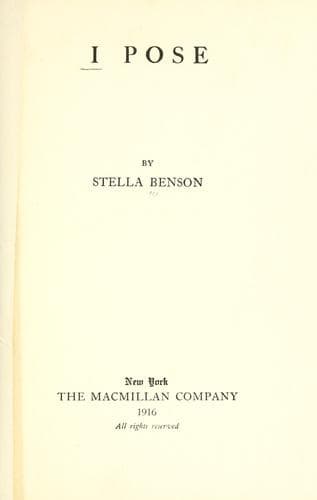
London (England) -- Fiction; Satire; Suffragists -- Fiction
“No. That’s the worst of it. They’re both here. Each acts as conscience
while the other one’s in power. Why wasn’t one brought into the world by
oneself?”
“Why, weren’t you?” asked Courtesy; “were you twins?”
“I still am. One of me is quite a good sort, really, almost an ‘Oh, my
dear’ girl. She is the one who was described in the paper as ‘Boadicea
Smith, a young woman of prepossessing appearance.’ The reporter went on
to say that the name was probably assumed—(which it was)—and that he
knew who I really was—(which he didn’t). He hinted that I was a deluded
patrician incog. Do you know, I treasure that paragraph as if it were a
love-letter. It’s the only compliment I ever had.”
“I should like to shake the hand of that reporter,” said the gardener.
“But after that he referred to me all through as ‘Smith,’ without
prefix, which is the sign of a criminal.”
“The puppy!” exclaimed the gardener.
“What were you doing to get into the paper?” asked Courtesy sternly. “I
never get into the paper.”
“It’s inconceivable that you should get into the paper, Courtesy dear,”
said the gardener, “except when you get born or married or dead.”
“It’d be like a sultana in a seed-cake,” said the suffragette, “or like
a sunrise at tea-time. Or as if a Forty-nine ’bus went to the Bank.”
I really think she was a little delirious, and perhaps she felt it
herself, for she added apologetically, “I always think Forty-nine is
such an innocent ’bus, it never knows the City.”
Next morning it was raining in the persistently militant sort of way
reserved by the weather for public holidays.
“A pity,” said the gardener at breakfast. “I meant to take you over to
the village to introduce you to Mr. Rust. And there are no ’buses or
taxis here.”
“Let’s dispense with the ’buses and taxis,” suggested the suffragette.
“Let’s forget London and get country-wet.”
“You’ll catch your death of cold,” said the gardener delightedly, and
presently they started.
“I don’t really want to be introduced to your friend,” said the
suffragette. “Only I wanted a chance to speak to you alone. Do you know,
beneath a militant exterior I am horribly shy?”
“It’s obvious,” retorted the gardener.
“Is it?” asked the suffragette, annoyed, and relapsed into silence for a
moment.
“I wanted to tell you ...” she began again presently, “that I beg your
pardon for coming here. It’s unforgivable of me. You know, as regards
men, I’m not a woman at all; I haven’t the unselfish instincts that
other women have. I came because I had—reached the limit—and I wanted a
friend....”
“Well, you didn’t come far wrong,” said the gardener. “I love you.”
“I didn’t think of your feelings at all, which is only another proof
that it is no good your loving me.”
“May I take the risk?”
The suffragette stopped, and stood leaning against the rain-whipped
wind. Rain was trapped in the mesh of her soft hair. She clenched her
fists upon her breast.
Public-domain text, read in full here on John Shaqi.
Reviews
Reviews
No reviews yet
Be the first to share your thoughts on this work.
Elsewhere in the archive
Join the Discussion
Join the discussion
Sign in to leave a comment or review.
Sign InorCreate an account