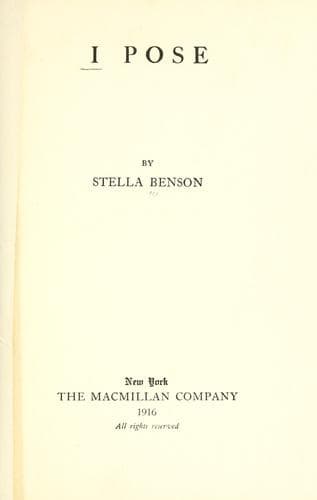
London (England) -- Fiction; Satire; Suffragists -- Fiction
“I have not worked for twenty-two years among the poor without reaching
a certain insight into character; I am not blind to such things,
whatever you may be, yerce, yerce. But that is beside the point. I
reminded Smith that he might be able to give her less important
employment—I was willing to help the girl up to a certain point. I
suggested a protégé of my own for the better post, to whom the generous
opportunity offered would be far more suitable, a very deserving young
man, who is debarred from ordinary employment by the loss of a leg. Mr.
Smith accepted my suggestion, and offered Jane Wigsky a post as packer,
at seven-and-six a week, a much larger wage than she has been getting
lately. She refused, and put the responsibility of her refusal on you.
She also mentioned that other girls in the Church Club were under your
influence on the question of wages. I made enquiries and found that my
sister’s club was in a fair way to turn into a female Trade Union, an
abominable anomaly. I took the only course possible. I dismissed all the
misguided girls from the Club. There is nothing more to be said.”
“Nothing,” said the suffragette, who had become very white, “except—what
must your God be like to have a servant like you?”
“If you are going to blaspheme,” said the priest, “kindly leave my house
at once.”
“If God is like that ...” she said, “I pray the Devil may win.”
She ran out of the house childishly, and slammed the door.
The gardener, on Tuesday morning, was parting his hair for the third
time, when he received a telegram:
“Don’t come.—Suffragette.”
It startled him, but not very much. He looked at the third attempt at a
parting in the glass, and saw that it was an excellent parting for a man
on his wedding-day. He reflected that a militant suffragette would
naturally tend to become ultra-militant on this final day. And if the
worst came to the worst, it could do no harm to go up and find out how
bad the worst was. So he went up to London by the eleven train.
He was to meet her at the little bun-shop that clings for protection to
the Brown Borough Town Hall. There the suffragette had a fourpenny meal
daily, and there they had arranged to have an eightpenny meal together,
before assuming the married pose. There was a “wedding-shop” round the
corner. I don’t suppose any couple ever made less impressive plans.
And the gardener pursued the plan. He entirely ignored the telegram.
I don’t know whether the suffragette was confident that he would obey
it, or that he would ignore it. I am entirely doubtful about her state
of mind on that day. But I know that when the gardener arrived at the
bun-shop she was there, facing the door, already half-way through her
fourpenny lunch. Which appears to show that—if her telegram was
genuine—she put implicit faith in his obedience. In this case she was
presumably displeased to see him. Her face, however, looked too tired to
change its expression in any way.
“Didn’t you get my wire?” she said.
Public-domain text, read in full here on John Shaqi.
Reviews
Reviews
No reviews yet
Be the first to share your thoughts on this work.
Elsewhere in the archive
Join the Discussion
Join the discussion
Sign in to leave a comment or review.
Sign InorCreate an account