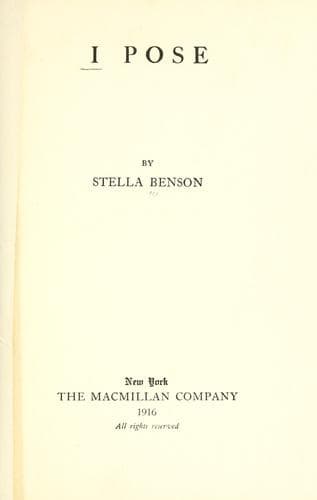
London (England) -- Fiction; Satire; Suffragists -- Fiction
“I am sorry he criticised the Bible in your hearing,” apologised Miss
Brown. “I am afraid he has a tendency towards irreverence.”
“I wish he had,” muttered Mr. Wise.
Acres of sugar filed past the window. High waved the proud crests of it,
all innocent of its mean latter end as a common comestible. The
suffragette’s mind laboured under a rocking confusion of green tufted
miles,—and somewhere on the outskirts of her thoughts, a little sallow
Albert entrenched behind an enormous pair of spectacles.
“A glorious child,” said the lady novelist, in her monopolising tones.
“Simply glorious. Quite an experience to have met him.”
“Good copy, eh?” grinned Mr. Wise.
“Excellent. You know I collect copy.”
Now the suffragette collected copy, but she did it without
self-consciousness. There are several kinds of copy-collectors. Some of
us squeeze our copy into little six-shilling novels, or hack it into so
many columns for the benefit of an unfeeling press. Some of us live
three-score years and ten, and then wake suddenly to find our
copy-coffers full. Upon which we become bores, and our relations hasten
to engage a paid companion for us. But some of us carry our lives about
with us sealed up in our holy of holies, and take pride in hiding the
precious burden that we bear. Copy-collecting may become a religion; to
the suffragette, who never put pen to paper for any one else’s benefit,
and who never told an anecdote, this pursuit was the great consolation
for a bleak life. At the gate of death, or on the step of Paradise, such
a soul may be found filling its pockets with the gold of secret
experience. I think the mania is most acute when no thought of eventual
print intrudes. Its most encouraging characteristic to the lonely is the
sense of irresponsibility it brings. After all I may go and turn
cart-wheels down the Strand, I may murder you, or throw my last shilling
into the Thames, I may go half-way to Hell, and if I miscalculate the
distance and fall in—it’s all copy. To the lady novelist, however, copy
was but a currency to spend. Every experience in her eyes formed a part
of a printed page, surrounded by a halo of favourable reviews. She never
wrote a letter without an eye on her posthumous biography, never met a
notable individual without taking a mental note for the benefit of a
future series of “Jottings about my Generation.” Both she and the
suffragette kept diaries, but only the suffragette’s had a lock and key.
The engine was approaching the climax of its daily task. It faltered.
Looking out of the window, Mr. Wise described its arrival at the foot of
a pronounced hill. The engine gazed up the perspective of its duty, and
panted prophetically, as pants an uncle before a game of stump-cricket.
“This hill is always a surprise to the engine,” said Mr. Wise. “Every
day it has two or three tries, and yet it never learns the knack.”
Public-domain text, read in full here on John Shaqi.
Reviews
Reviews
No reviews yet
Be the first to share your thoughts on this work.
Join the Discussion
Join the discussion
Sign in to leave a comment or review.
Sign InorCreate an account