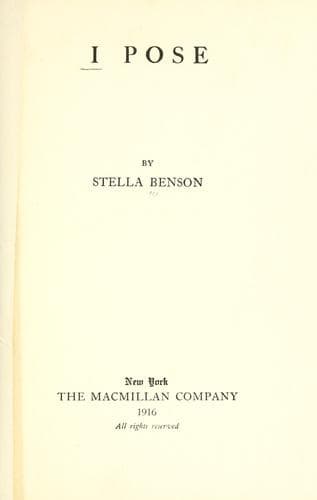
London (England) -- Fiction; Satire; Suffragists -- Fiction
The suffragette’s fingers tore at the arm of her chair. It was not only
too hot to travel, it was also much too hot to cease to travel. She felt
a crisis approaching.
Her window had stopped artistically opposite a little slice of distant
world, carved out between the trunks of two great cotton trees. Union
Town, perceptibly diminished since its last appearance, languished again
around its bay. Against the white water you could see the cathedral and
the factory chimneys, the spires of God and the spires of mammon.
The suffragette, as she looked, saw the cathedral spire cock suddenly
awry and bend over, like a finger in three joints.
“The heat,” she thought. “I believe I’m dying.”
Almost at once after that the train suffered a great spasm, as though
yearning for the top of the hill.
“She’s going to try again,” said Mr. Wise.
The suffragette’s head cocked suddenly awry, she bent over in three
joints like a finger, and slid off her chair in a faint.
A prostrated suffragette is a contradiction in terms. This one became a
child, lying in ungraceful angles, in need of its mother.
“By Jove!” said Mr. Wise. Miss Brown, after lifting up her skirt
carefully, knelt upon her petticoat.
An ebony ticket-inspector rushed into the compartment.
“Ull right! Ull right!” he shouted. “Ull ovah! Nobuddy killed!”
“Certainly not,” said Mr. Wise. “Why should they be? Only a faint.”
“Earthquake, sah, earthquake!” yelled the inspector. “Jes’ look at the
steeple daown in taown!”
There was no steeple to look at.
“My—what an eventful journey!” said the lady novelist.
“Poor little thing,” said Miss Brown to the suffragette, in almost human
tones. “Better now, better now?”
The suffragette began to struggle a little. Even had she been in her
grave, I think pity would have aroused a spark of militant protest in
her bones.
“Tell her to make an effort,” said the lady novelist, who had never in
her forty years been guilty of physical weakness. “Pretend not to notice
her. Probably hysteria.”
This well-worn accusation touches a familiar chord in the ear of any
rebel. It opened one of the suffragette’s eyes. She had black eyebrows
which suggested that she might have fine eyes, but she had not. When her
eyes were shut you only saw the hopeful suggestion.
“Come, come,” said Miss Brown, handing Mr. Wise’s brandy flask back to
him, and becoming aware that her petticoat was bare to the gaze of an
unmarried gentleman and a negro inspector. “Might I trouble you to lift
the young lady on to a chair?” she added, as she rose.
Seven stone of political agitator takes but little time to move.
“A most eventful journey,” said the lady novelist.
Miss Brown, now decently seated on a chair, stroked the suffragette’s
hand. “Are you going to friends, my child?” she asked.
“No, enemies, I expect,” said the suffragette drearily.
“Where?”
“I don’t know.”
“You must know where you are going,” said the novelist severely.
Public-domain text, read in full here on John Shaqi.
Reviews
Reviews
No reviews yet
Be the first to share your thoughts on this work.
Elsewhere in the archive
Join the Discussion
Join the discussion
Sign in to leave a comment or review.
Sign InorCreate an account