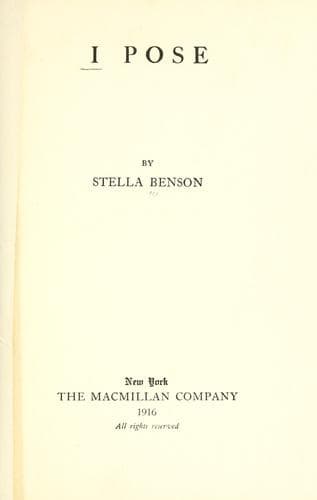
London (England) -- Fiction; Satire; Suffragists -- Fiction
“Booked to Greyville,” said the inspector, who had picked up her ticket,
and was thoughtfully clipping it all over.
“Do you know any one in Greyville?” asked Miss Brown.
“No.”
“Were you going to an hotel?”
“I suppose so.”
Some kind deeds are so obvious that they are impossible to escape.
“Albert can move into the back room,” said Miss Brown.
And the train, as if relieved to have this affair settled, moved on up
the hill.
By the time the chapel bell, which Island engines always wear, had begun
to sound its warning to the pigs upon the line at Greyville Junction,
the suffragette’s independence was a thing dissolved. Her protests had
no weight. Constitutionally she was unable to be politely firm. She must
either be militant or acquiescent; she knew not the half measures of
civilisation. And it was impossible to be militant in the face of Miss
Brown’s impersonal sense of duty.
“If only she had been a more interesting person this might have been
like the beginning of a novel,” murmured the lady novelist to Mr. Wise.
That young man, who was wearing the sheepish look peculiar to the
Englishman in the presence of matters which he considers to be feminine,
shrugged his shoulders.
At Greyville station Miss Brown emerged like an empress from incognito.
A black coachman, with so generous an expanse of teeth that you
suspected them of being the only line of defence between you and the
inner privacies of his brain, was on the platform. He seemed torn
between acquired awe of Miss Brown, and an innate desire to conduct the
welcome heartily. The station-master bowed. The porter chirruped to
Scottie.
“New visitor, missis?” gasped the coachman, looking at the suffragette.
He had taken some time to assimilate the visitorship of the lady
novelist. His mind was being educated at too great a speed.
“Gorgeous fellow,” said the lady novelist, who considered all black
people gorgeous because they were not white. The conversation of John
the coachman had already filled two note-books, though he had never said
anything original in his life.
There is so much superfluous sunshine in Trinity Islands that splashes
of it have been lavished upon all sorts of unnecessary details, the
lizards, and the birds, and the self-conscious orchids roosting in the
trees. Some of it has even been rolled into the roads, making them white
and merry and irresponsible. The buggy horses feel the tingle of it, for
they seldom walk; although the Creator specialised in hills on Trinity
Island.
Down from some lofty market came the peasant women; their children,
their donkeys, their tawdry clothes, trappings and merchandise, soaked
with sun. Fantastic in outline, fairies of a midsummer day’s dream, the
little donkeys capered on spindle legs, bestridden by wide panniers, and
by the peasant women, riding defiantly like brigands, with bandanas
round their heads, and sun-coloured draperies.
Public-domain text, read in full here on John Shaqi.
Reviews
Reviews
No reviews yet
Be the first to share your thoughts on this work.
Elsewhere in the archive
Join the Discussion
Join the discussion
Sign in to leave a comment or review.
Sign InorCreate an account