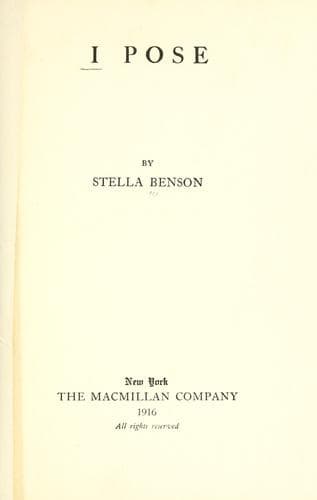
London (England) -- Fiction; Satire; Suffragists -- Fiction
The carrying of the suit-case was a physical impossibility to one of the
suffragette’s lack of muscle. But to her impossibility was only an
additional “Anti” to fight, a rather worthier enemy than the rest. She
believed in the power of the thought over the deed, that was her
religion, and one is tempted to wonder whether any more complex belief
is needed. Has it ever been proved that the human will, if reverently
approached, is not omnipotent?
At any rate the suit-case, borne by a thing that looked like the
suffragette, but was in reality a super-suffragette created for the
occasion, travelled to the hotel, unmolested by duppies, but followed by
a literary lady poisoned by injured pride.
At the hotel were many Americans who said, “I guess” and “Bully” and “I
should worry,” and all the things that make a second-rate copy collector
swell with copy and feel exquisitely cosmopolitan. This collector’s
diary began to overflow to three or four foolscap sheets a day, closely
covered with dialogues on trivial subjects by very ordinary American
husbands and fathers; all Americanisms underlined and spattered with
liberal exclamation marks.
At the end of the second week of the lady novelist’s stay at the hotel
arrived a millionaire, who immediately became the gem of the collection.
He was exactly modelled on the stock millionaire to be met with in the
pages of the comic papers. He was lean, self-made, and marvellously
dressed; he wore eyeglasses and a little stitched-linen hat tilted over
them. Also the beard of a goat. At the very outset he expressed himself,
“Vurry happy to meet you, madam, always happy to meet any of our
neighbours from across the duck-pond.” It was almost too good to be
true. The novelist followed him about, so to speak, with fountain pen
poised.
His conversation was almost entirely financial. Neither the lady
novelist nor I understand such matters well enough to write them down,
but only I am wise enough not to try.
“Do you mind if I say you are a treasure?” asked the lady novelist,
after listening for an hour to a dissertation on Wall Street.
“Not at all, ma’am,” replied the millionaire politely, and drew breath
to continue his discourse. But he rewarded her by descending to the
level of her intelligence.
“Say, talking of money, I guess there’ve been more fine opportunities
lorst in Union Town this last fortnight, than ever I missed since I
commenced collecting the dollars. Would you believe me—there’s a fellow,
by name Dallas Tring, who’s inherited the only flour dee-pot in Union
Town. Uncle’s orfice crumpled in on Uncle during the quake, and left
Tring his fill of dollars right there for the picking up, so to speak.
Union Town wants flour at this crisis, and if it was mine I’d say that
Union Town, or the British Government, had darn well got to pay for it.
We don’t calc’late in hearts, this side of heaven, but in hard dollars.
Philanthropy’s a fool-game.”
“You are simply priceless,” said the lady novelist. “Please go on.”
Public-domain text, read in full here on John Shaqi.
Reviews
Reviews
No reviews yet
Be the first to share your thoughts on this work.
Elsewhere in the archive
Join the Discussion
Join the discussion
Sign in to leave a comment or review.
Sign InorCreate an account