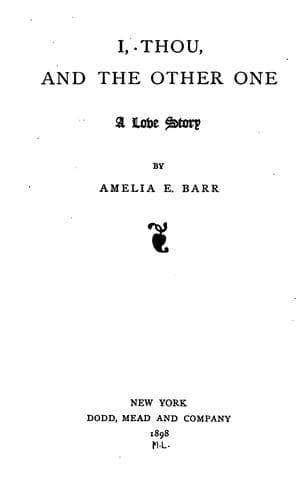
I, Thou, and the Other One: A Love StoryBarr, Amelia E.
General
I, Thou, and the Other One: A Love Story
Barr, Amelia E.
Fiction; Love stories
"I cannot spare a thousand pounds. My expenses have been very great this
past winter."
"Still, I shall require a thousand pounds."
The Duchess had just left her husband with this question to consider.
He did not want to part with a thousand pounds, and he did not want
to part with Annabel. She was the brightest element in his life. She had
become dear to him, and the thought of her fortune made his financial
difficulties easier to bear. For the encumbrances which the times forced
him to lay on his estate need not embarrass Piers; Annabel's money
would easily remove them.
He was under the influence of these conflicting emotions, when Piers
entered the room, with a brusque hurry quite at variance with his natural
placid manner. The Duke started at the clash of the door. It gave him a
twinge of pain; it dissipated his reveries; and he asked petulantly,
"What brings you here so early, and so noisily, Piers?"
"I am in great trouble, sir. Squire Atheling--"
"Squire Atheling again! I am weary of the man!"
"He has forbidden me to see Miss Atheling."
"He has done quite right. I did not expect so much propriety from him."
"Until you give your consent to our marriage."
"Why, then, you will see her no more, Piers. I will never give it.
Never! We need not multiply words. You will marry Annabel."
"Suppose Annabel will not marry me?"
"The supposition is impossible, therefore unnecessary."
"If I cannot marry Miss Atheling, I will remain unmarried."
"That threat is as old as the world; it amounts to nothing."
"On all public and social questions, I am your obedient son and
successor. I claim the right to choose my wife."
"A man in your position, Piers, has not this privilege. I had not. If
I had followed my youthful desires, I should have married an Italian
woman. I married, not to please myself, but for the good of Richmoor;
and I am glad to-day that I did so. Your duty to Richmoor is first; to
yourself, secondary."
"Have you anything against Miss Atheling?"
"I object to her family--though they are undoubtedly in direct descent
from the royal Saxon family of Atheling; I object to her poverty; I
object to her taking the place of a young lady who has every desirable
qualification for your wife."
"Is there no way to meet these objections, sir?"
"No way whatever." At these words the Duke stood painfully up, and
said, with angry emphasis, "I will not have this subject mentioned to me
again. It is dead. I forbid you to speak of it." Then he rang the bell
for his Secretary, and gave him some orders. Lord Exham leaned against
the mantelpiece, lost in sorrowful thought, until the Duke turned to
him and said,--
"I am going to ride; will you go with me? There are letters from
Wetherell and Lyndhurst to talk over."
"I cannot think of politics at present. I should be no help to you."
"Your mother and Annabel are thinking of going to Germany. I wish you
would persuade them to stop at home. Is Annabel sick? I am told she is."
"I do not know, sir."
Public-domain text, read in full here on John Shaqi.
Reviews
Reviews
No reviews yet
Be the first to share your thoughts on this work.
Elsewhere in the archive
Join the Discussion
Join the discussion
Sign in to leave a comment or review.
Sign InorCreate an account