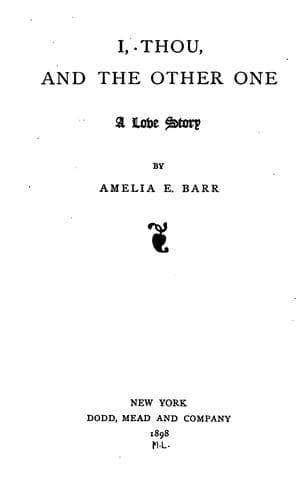
I, Thou, and the Other One: A Love StoryBarr, Amelia E.
General
I, Thou, and the Other One: A Love Story
Barr, Amelia E.
Fiction; Love stories
"As for the possibility of the House of Lords preventing a
reform of Parliament, I hold it to be the most absurd notion
that ever entered into human imagination. I do not mean to
be disrespectful, but the attempt of the Lords to stop the
progress of Reform reminds me very forcibly of the great
storm at Sidmouth, and of the conduct of the excellent
Mrs. Partington on that occasion. In the winter of 1824,
there set in a great flood upon that town; the waves rushed
in upon the houses; and everything was threatened with
destruction. In the midst of this sublime and terrible storm,
Dame Partington--who lived upon the beach--was seen at the
door of her house, with mop and pattens, trundling her mop,
squeezing out the sea-water, and vigorously pushing away the
Atlantic Ocean. The Atlantic was roused. Mrs. Partington's
spirit was up; but I need not tell you, the contest was
unequal. The Atlantic Ocean beat Mrs. Partington. She was
excellent at a slop or a puddle; but she should not have
meddled with a tempest. Gentlemen, be at your ease, be quiet
and steady. You will beat Mrs. Partington."[2]
------
[Footnote 2: Speech at Taunton by Sydney Smith, October 12, 1831.]
"It was not respectful to liken the Lords of England to an old woman,
now was it, Mother?" asked the Squire.
But Mrs. Atheling only laughed the more, and the conversation drifted so
completely into politics that Kitty and Annie grew weary of it, and said
they wished to go to their rooms. And as they left the parlour together,
Edgar suddenly stayed Kitty a moment, and said, "I had nearly forgotten
to tell you something. Miss Vyner is to be married, on the second of
December, to Cecil North. I am going to London in time for the wedding."
And Kitty said, "I am glad to hear it, Edgar," and quickly closed the
door. But she lay long awake, wondering what influence this event would
have upon Piers and his future, until, finally, the wonder passed into
a little verse which they had learned together; and with it singing in
her heart, she fell asleep:--
"Thou art mine! I am thine!
Thou art locked in this heart of mine;
Whereof is lost the little key:
So there, forever, thou must be!"
CHAPTER FOURTEENTH
AT THE WORST
Public-domain text, read in full here on John Shaqi.
Reviews
Reviews
No reviews yet
Be the first to share your thoughts on this work.
Elsewhere in the archive
Join the Discussion
Join the discussion
Sign in to leave a comment or review.
Sign InorCreate an account