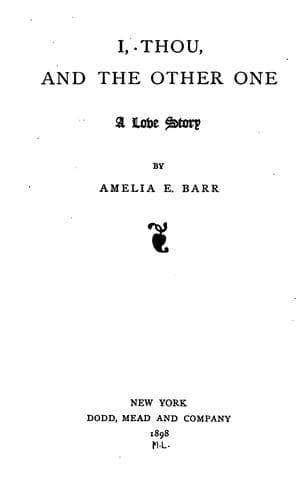
I, Thou, and the Other One: A Love StoryBarr, Amelia E.
General
I, Thou, and the Other One: A Love Story
Barr, Amelia E.
Fiction; Love stories
He had hardly sat down to eat, when Piers Exham came in. No one could
have been more welcome, and the young man's troubled face brightened
in the sunshine of Kate's smile, and in the honest kindness of the
Squire's greeting. "I was just going to tell Mrs. Atheling all I knew
about to-night's blundering," he said; "but now we will have your
report first, for you have seen the Duke, I'll warrant."
"Indeed, Squire, the Duke is not dissatisfied--though the general
opinion is, that the Duke of Wellington has committed an egregious
mistake."
"I shouldn't wonder. Wellington does not know the difference between
a field-marshal and a Cabinet Minister. What did he say?"
"He said that as long as he held any office in the Government, he would
resist Reform. He said there was no need of Reform; that we had the best
government in the world. The Duke of Devonshire, whom I have just seen,
told me that this statement produced a feeling of the utmost dismay, even
in the calm atmosphere of the House of Lords."
"Calm!" interrupted the Squire. "You had better say, Incurable
prosiness."
"Wellington noticed the suppressed excitement, the murmur, and the
movement, and asked Devonshire in a whisper, 'What can I have said to
cause such great disturbance?' And Devonshire shrugged his shoulders
and answered candidly, 'You have announced the fall of your government,
that is all.'"
"Wellington considers the nation as a mutinous regiment," answered the
Squire. "He thinks the arguments for Reformers ought to be cannon balls;
but Englishmen will not endure a military government."
"It would be better than a mob government, Squire. Remember France."
"Englishmen are not Frenchmen," said Kate. "You ought to remember
_that_, Piers. Englishmen are the most fair, just, reasonable, brave,
loyal, honourable people on the face of the earth!"
"Well done, Kitty!" cried the Squire. "It takes a little lass like
thee to find adjectives plenty enough, and good enough, for thy own. My
word! I wish thou couldst tell the Duke of Wellington what thou thinkest
of his fellow-citizens. He would happen trust them more, and treat them
better."
"There is Mr. Peel too," she continued. "Both he and the Duke of
Wellington are always down on the people. And yet the Duke has led these
same people from one victory to another; and Mr. Peel is one of the
people. His father was a day-labourer, and he ought to be proud of it;
William Cobbett is, and William Cobbett is a greater man than Robert
Peel."
"Now then, Kitty, that is far enough; for thou art wrong already.
Cobbett isn't a greater man than Peel; he isn't a great man at all,
he is only a clever man. But the man for my money is Henry Brougham. He
drives the world before him. He is a multitude. He had just one idea
to-day,--Reform and again Reform. He played that tune finely to the
House, and they danced to it like a miracle. Much good it will do them!"
Public-domain text, read in full here on John Shaqi.
Reviews
Reviews
No reviews yet
Be the first to share your thoughts on this work.
Elsewhere in the archive
Join the Discussion
Join the discussion
Sign in to leave a comment or review.
Sign InorCreate an account