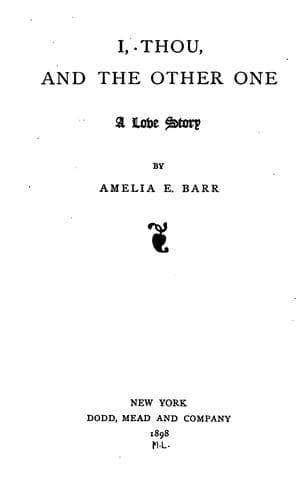
I, Thou, and the Other One: A Love StoryBarr, Amelia E.
General
I, Thou, and the Other One: A Love Story
Barr, Amelia E.
Fiction; Love stories
"I am in love with Annabel Vyner. I worship none of the idols that have
been set up, either by Tories or Reformers. Men who talk politics are
immensely stupid. I shall marry a man who is a good fighter. Mere talkers
are like barking dogs. Why don't these Reformers stop whimpering, and
fly like a bull dog at the throat of their wrongs? Then I should go
with them, heart and soul and purse."
"You are talking now for talking's sake, Annabel. You are actually
advocating civil war."
"Am I really? Well, war is man's natural condition. It takes churches,
and priests, and standing armies, and constables always on hand, to
keep peace in any sort of fashion. We are all barbarians under our
clothes,--just civilised on the top."
"Such assertions are odious, and you cannot prove them."
"I can. The other evening I was reading to Lord Tatham a most exquisite
poem by that young man Tennyson; and he seemed to be enjoying it,
until Algernon Sydney showed him his watch, and said something about
'the Black Boy.' Then his face fairly glowed, and he went off with a
compliment that meant nothing. The next morning I found out 'the
Black Boy' was a famous pugilist. We are all of us, in some way or
other, in this mixed condition."
"I think you are particularly disagreeable this morning, Miss."
"Pardon, Duchess. We have fallen on a disagreeable subject. Let us
change it. Are we to drive to Richmond to-day?"
"If Piers will accompany us. Ay! that is his knock." She turned a
radiant face to meet her son, but received a sudden chill. Piers was
pale and sombre-looking; he said he had not slept, and politely declined
the Richmond excursion. Annabel was sure he would. "He will have an
explanation at the Athelings instead," she thought; and she waited
curiously for some remark which might open the way for her confession--or
else close it. But Lord Exham did not allude to his loss, and the
Duchess either attached no importance to the subject, or else thought it
too important to bring forward. The tone of the room was not brightened
by the young lord's advent, and Annabel quickly excused herself from
further attendance.
"He will tell his mother when I am not there; and I shall get his
opinions, with commentaries from her," she thought, as she hurried
to her own rooms. Once there, she dismissed her maid, and sat down
to realise herself. She doubled her little hands, and beat her knees
softly with them. It was her way of summoning her mental forces, and of
collecting vagrant and undecided thought.
Public-domain text, read in full here on John Shaqi.
Reviews
Reviews
No reviews yet
Be the first to share your thoughts on this work.
Elsewhere in the archive
Join the Discussion
Join the discussion
Sign in to leave a comment or review.
Sign InorCreate an account