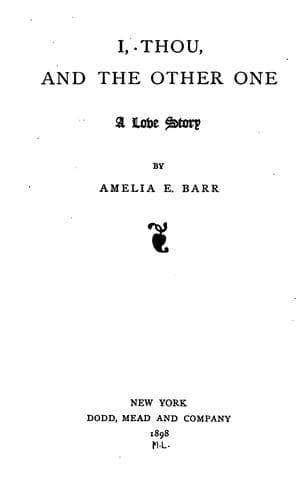
I, Thou, and the Other One: A Love StoryBarr, Amelia E.
General
I, Thou, and the Other One: A Love Story
Barr, Amelia E.
Fiction; Love stories
"Nay, I am not. When I can shut my ears as easy as my eyes, I can afford
to be less particular about the company I keep. I know beforehand what
the women in that crowd will say about their own danger, and about the
murmuring poor who won't starve in peace, and I know that I would be
sure to answer them with a little bit of plain truth."
"And the truth is not always pleasant, eh, Maude?"
"In this case I'm sure it wouldn't be pleasant. So, then, the outside
of Richmoor House is the best side for me."
"I must say I'm getting a bit tired myself of the Duke's masterful
way, and of his everlasting talk about the 'noble memories of the
past.'"
"Then tell him, John, that the noble hopes of the future are something
better than the noble memories of the past. The country is in a bad
condition as ever was. Something must be done, and done quickly."
"I'm saying nothing to the contrary, Maude. But even if Reform was
right, it cannot be carried. We must drive the nail that will go. That
is only good common-sense, Maude."
"Mark my words, John. Reform will _have_ to come, and better now than
later. That which fools do in the end, wise men do in the beginning. I
know, I know."
"On this subject thou knowest nothing whatever, Maude. Now, then, I
am going to have a bit of sleep. But I will say thus far--as soon as
ever I am sure that I am on a wrong road I won't go a step further.
John Atheling is not the man to carry a candle for the devil."
With these words he threw his bandana handkerchief over his head,
adding, "He hoped now he had a 'right' to a bit of sleep." Then Mrs.
Atheling went softly out of the room. There was a tolerant smile on her
face, for she was not deceived by the Squire's habit of dignifying his
self-assertions and his self-indulgences with the name of "rights."
CHAPTER TENTH
TROUBLE COMES UNSUMMONED
Never had the ducal palace of Richmoor been more splendidly prepared
for festivity than on the night of the first of March, 1831. And yet
every guest present knew that it was not a festival, but a gathering
of men and women moved by the gravest fears for the future. The long
suites of parlours, brilliantly lighted, were crowded with peers and
noble ladies, wearing, indeed, the smiles of conventional pleasure; but
all of them eager to discuss the portentous circumstances by which they
were environed.
Public-domain text, read in full here on John Shaqi.
Reviews
Reviews
No reviews yet
Be the first to share your thoughts on this work.
Elsewhere in the archive
Join the Discussion
Join the discussion
Sign in to leave a comment or review.
Sign InorCreate an account