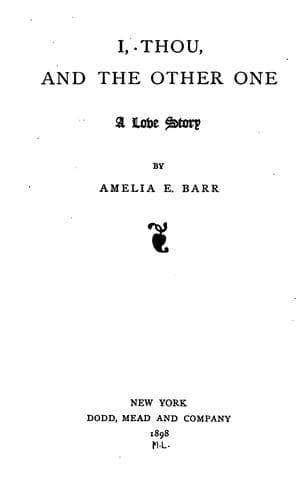
I, Thou, and the Other One: A Love StoryBarr, Amelia E.
General
I, Thou, and the Other One: A Love Story
Barr, Amelia E.
Fiction; Love stories
"He supposed the case of a stranger, coming to England to investigate
our method of representation, being taken to a green mound, and told
that green mound sent two members to Parliament; or to a stone wall
with three niches in it, and told that those three niches sent two
members to Parliament; or to a green park with no signs of human
habitation, and told that green park sent two members to Parliament;
and then pictured the amazement of the stranger at this condition of
things. 'But,' he cried, 'how much greater would be his amazement if
he were then taken to large and populous cities, full of industry,
enterprise, and intelligence, and containing vast magazines of every
kind of manufactures, and was then told that these cities did not send
a single man to represent their rights and their necessities in the
great national council.' It was really a very effective passage."
"We have heard that argument before; it is stale and unprofitable,"
said the Duchess.
"Listen! This Bill proposes to give every man paying taxes for houses
of the yearly value of ten pounds and upward--_a vote_."
"What an absurdity!"
"It proposes to give Manchester, Birmingham, Leeds, Sheffield, and
three other large towns, each two members, and London eight additional
members."
"Infamous! It will give us a mob government."
"This so-called Reform Bill gives the franchise to one hundred and
ten thousand people in the counties of England who never had it before;
in the provincial towns, it gives it to fifty thousand; in London, it
gives it to ninety-five thousand; in Scotland, to fifty thousand; and
in Ireland, to forty thousand: in all, half a million of persons are to
be added to the constituency of the House of Commons."
At this information the tendency of the whole company was to laughter.
Indeed the Duke's face, and voice, and manner was that of a man telling
an utterly absurd story. Such sweeping alterations were not conceivable;
their very excess doomed them to ridicule and failure, in the opinion of
the privileged class; but the Duke of Wellington's face expressed an
anxiety not consonant with this feeling; and he asked gloomily:
"Did Lord John Russell _dare_ to read the names of the boroughs he
intends to disfranchise, with their members present?"
"He read them with the greatest emphasis and deliberation."
"And the result? What was the result? How did they take being robbed of
their seats in this summary way?"
"The excitement in the House was incredible. He was derisively
interrupted by shouts of laughter, and by cries of 'Hear! Hear!' and
by constant questions across the table from the members of those
boroughs. The wisest statesmen in the House were aghast at proposals so
sweeping and so revolutionary."
"What did Peel say?"
Public-domain text, read in full here on John Shaqi.
Reviews
Reviews
No reviews yet
Be the first to share your thoughts on this work.
Elsewhere in the archive
Join the Discussion
Join the discussion
Sign in to leave a comment or review.
Sign InorCreate an account