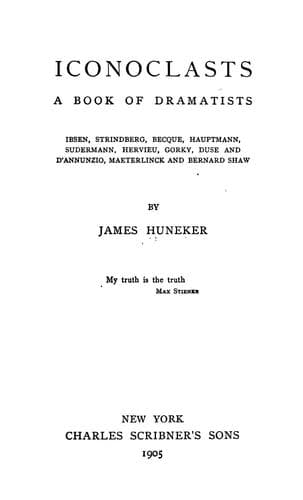
Iconoclasts: A Book of Dramatists: Ibsen, Strindberg, Becque, Hauptmann, Sudermann, Hervieu, Gorky, Duse and D'Annunzio, Maeterlinck and Bernard ShawHuneker, James
History
Iconoclasts: A Book of Dramatists: Ibsen, Strindberg, Becque, Hauptmann, Sudermann, Hervieu, Gorky, Duse and D'Annunzio, Maeterlinck and Bernard Shaw
Huneker, James
Dramatists; European drama -- 19th century -- History and criticism; European drama -- 20th century -- History and criticism
But Shaw only removed another of his innumerable masks. Beware, says
Nietzsche, of the autobiographies of great men. He was thinking of
Richard Wagner. His warning applies to Bernard Shaw, who is a great
comedian and a versatile. He has spoken through so many different
masks that the real Shaw is yet to be seen. Perhaps on his death-bed
some stray phrase will illuminate with its witty gleam his true soul's
nature. He has played tag with this soul so long that some of it has
been lost in the game. Irishman born, he is not genial after the Oliver
Goldsmith type; he resembles much more closely Dean Swift, minus that
man's devouring genius. When will the last mask be lifted--and, awful
to relate, will it, when lifted, reveal the secret? A master hypnotist
perhaps he may be, illuding the world with the mask idea. And what a
comical thing it would be to find him smiling at the end and remarking,
"I fooled you, Brethren, didn't I?" In his many rôles one trait
has obstinately remained, the trait of irresistible waggery. Yet we
sadly suspect it. What if this declaration of charlatanism were but a
mask! What if Shaw were really sincere! What if he really meant to be
sincere in his various lectures and comedies! What if his assumption
of insincerity were sincere! His sincerity insincere! The thought
confuses. In one of his plays--The Philanderer--a certain character has
five or six natures. Shaw again, _toujours_ Shaw!
Joke of all jokes, I really imagine that Shaw is a sentimentalist in
private; and that he has been so sentimental, romantic, in his youth,
that an inversion has taken place in his feelings. Swift's hatred of
mankind was a species of inverted lyricism; so was Flaubert's; so may
be Shaw's. Fancy him secretly weeping over Jane Eyre, or holding a baby
in his lap, or--richest of all fancies--occasionally eating sausage and
drinking beer! I met him, once upon a time, in Bayreuth. He spoke then
in unmeasured terms of its beer drinkers, and added, without the ghost
of a smile, that breweries should be converted into insane asylums.
Whether we take him seriously or not, he is a delightful, an
entertaining writer. His facile use, with the aid of the various
mouthpieces he assumes at will, of the ideas of Nietzsche, Wagner,
Ibsen, and Strindberg, fairly dazzles. He despises wit at bottom, using
its forms as a medium for the communication of his theories. Art for
art's sake is a contradiction to this writer. He must have a sense of
beauty, but he never boasts of it; rather does he seem to consider it
something naked, almost shameful--something to be hidden away. So his
men are always deriding art, though working at it like devils on high
pay. This puritanical vein has grown with the years, as it has with
Tolstoy. Only Shaw never wasted his youth in riotous living, as did
Tolstoy.
Public-domain text, read in full here on John Shaqi.
Reviews
Reviews
No reviews yet
Be the first to share your thoughts on this work.
Elsewhere in the archive
Join the Discussion
Join the discussion
Sign in to leave a comment or review.
Sign InorCreate an account