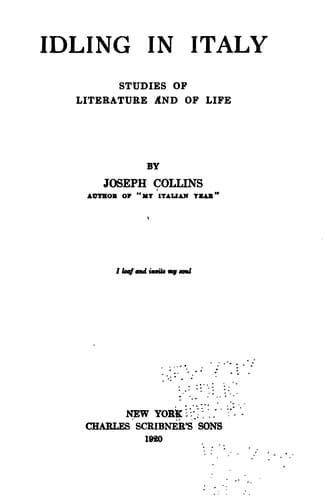
Idling in Italy: Studies of literature and of lifeCollins, Joseph
History
Idling in Italy: Studies of literature and of life
Collins, Joseph
Italian literature -- History and criticism
Forte Tiburtino is three miles beyond Rome on the road to Tivoli. The
train is switched at the Portonaccio station to the rails of the tramway
and goes directly to the gates of the hospital. It was the first day of
autumn, the wind was blowing a gale, whereby the unfortunates arrived in
a cloud of dust which must have added to their suffering. But that was
as nothing, I fancy, compared with the pain and ignominy put upon them
by the antics of one of my countrywomen clad in the uniform of an
American relief organization, an affable Amazon who, approaching her
physiological Rubicon, had begun to display somatically and emotionally
the results of disturbance and inadequacy of those wondrous internal
secretions that give elasticity to the skin, lustre to the hair, sparkle
to the eye, and appearance of health to the _tout ensemble_. She but
heightened her painful plainness by a stereotyped smile which, while
displaying a row of long teeth, set at an obtuse angle, accentuated the
aquilinity of her nose and the prognathousness of her jaw. Everywhere I
looked she was there. Every place I went I heard her: "Bentornato,"
"Benvenuto," "Aspetti un memento, farò la sua fotografia." The ways of
the Lord are obscure. Otherwise one could explain why he did not let
these poor devils die without having thrust upon them this presence,
voice, and affected cheer. I saw them, weak and prostrated as they were,
shrink from her as one might shrink from a famished alligator.
They opened the side doors of the cars and put steps against them; the
white-clad orderlies came down first, and then began the procession of
the weak, the emaciated, the forlorn, the desolate. Some were able to
descend unaided, others had to be helped, one on either side, and still
others dropped inert and corpse-like, across the strong back of an
orderly who carried them the few feet to a stretcher. Now and then one
would step out with an air of attempted jauntiness and a feeble smile,
but for the most part it was a procession of those who had lost hope,
who had abandoned faith in every one and everything, and who read over
the portal, "_Lasciate ogni speranza voi ch'entrate_." It is some such
procession that Dante must have encountered frequently in his passage
through the infernal regions. "_Nulla speranza gli comforta mai nonchè
di posa, ma di minor pena._" Not only did their faces reveal absolute
despair but their bodies were reduced to such a state of emaciation that
they were scarcely recognizable as human beings. Major Pohlmanti
afterward told me that the majority of them had lost upward of forty per
cent in weight, some of them, indeed, as much as sixty per cent. Many of
them were so scantily clad that their chests and legs and arms were
bare. Some were without socks, and their bony feet, thrust into cloth
shoes with wooden soles, gave the finishing touch to what seemed to be
animated skeletons covered with dirty brown paper which had been soaked
in putrid oil.
Public-domain text, read in full here on John Shaqi.
Reviews
Reviews
No reviews yet
Be the first to share your thoughts on this work.
Elsewhere in the archive
Join the Discussion
Join the discussion
Sign in to leave a comment or review.
Sign InorCreate an account