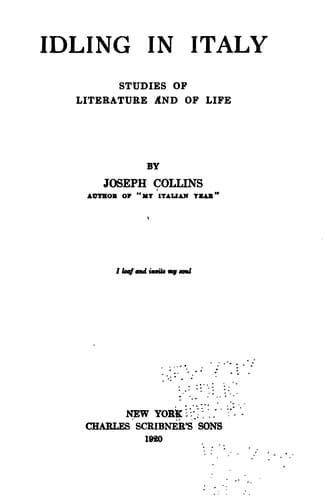
Idling in Italy: Studies of literature and of lifeCollins, Joseph
History
Idling in Italy: Studies of literature and of life
Collins, Joseph
Italian literature -- History and criticism
It was vouchsafed me to be in a position during the last year of the war
to see at short range and sometimes from a vantage-point the workings of
the minds of a people who have had liberty, unity, and nationality on
their tongues and in their hearts for half a century and more. The
Italians were in the lime-light from the day Germany threw a brand laden
with explosives and poison gases into the different Christian countries
of Europe. Her conduct as a whole since that time has been one of
dignity, honesty, responsibility, and the exponent of the highest ideals
of nationality. Whether or not she succeeded at any time in gaining the
complete and absolute confidence of her allies, it would be difficult to
say. To get the confidence of an individual or a country you must trust
them, and the more implicitly you trust the greater will be the
confidence and the finer the quality. Every one knows that Italy's
alliance with Austria was an unnatural one and the majority of her
people have always believed that the issue of it would be disastrous.
Even the most shallow student of history knows that Austria stood
menacingly over Italy during the entire period of the unholy alliance,
but never more insultingly so than in 1912, when she veritably defended
Turkey, while Italy was at war with that country. When Italy decided to
throw her lot in with the Allies, there is no doubt whatsoever that it
was with the hearty approbation of the vast majority of her people. The
treaty which her minister of foreign affairs, Sonnino, made with the
Allies, and which is known as the Treaty of London, and which sets forth
what Italy was to have when victory was hers, although not known to the
people, was satisfactory to the government, and one who reads it now can
readily understand why it was so. The question was--would it be
satisfactory to other governments? Was it an instrument consistent with
the new liberty? Was it not at variance with what was going to be
considered a fundamental right of the people, the principle of
self-determination?
Public-domain text, read in full here on John Shaqi.
Reviews
Reviews
No reviews yet
Be the first to share your thoughts on this work.
Elsewhere in the archive
Join the Discussion
Join the discussion
Sign in to leave a comment or review.
Sign InorCreate an account