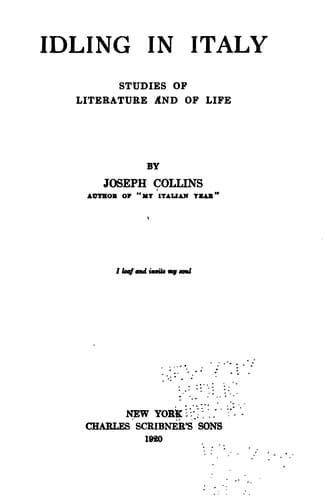
Idling in Italy: Studies of literature and of lifeCollins, Joseph
History
Idling in Italy: Studies of literature and of life
Collins, Joseph
Italian literature -- History and criticism
And now that the people who have lived and died, toiled and wrought,
suffered and supplicated through fifty-two months of agony have won,
there will arise from those who have survived a dominant chorus which
will insist upon the fulfilment of the promises that were made them to
incite them to victory. Their hopes and desires and aspirations must be
satisfied. I am one of those who believe that they will make their
demands orderly and insistently, and not by means of revolution or
serious disturbance of order. They will work out their salvation by
mutual co-operation, not only amongst themselves but with those who are
the leaders of the world's thought, many of whom have been heretofore of
the privileged classes, but they will insist upon certain fundamental
things which I have previously enumerated, and the foremost of which is
the dispersion of great wealth, particularly hereditary wealth. The
revolutionary Socialist sees an easy solution of the matter in the
giving of the wealth to the masses and of recognizing no other source of
wealth except labor, but that is not the kind of Socialist who will have
to do with the reordering of the world that is now being born. It is the
Socialist who is to-day frequently called the individualist, who
believes that the dissipation of individual property and initiative will
spell a greater ruin for the masses than for the individual and who
believes in harmonizing the principles of individual liberty with those
of solidarity, who will be the Socialist of the New Era.
The future state will be arbitrary only in so far as it is the
expression of the collected, united force of its citizens. They will
really make its laws, not have them made for them by capital or
privileged interests; they will enforce them impartially, and it is
devoutly to be hoped the external force of such peoples will be
conventionized in such a way with other peoples that armies and navies
will practically cease to exist. The basis of such hope is in the League
of Nations, for then we shall have a world-state which shall make
international law or convention subject to law and enforcement. Once the
fear of invasion of a country is overcome and once the principles of
nationality can be established and put into operation, there will be no
reason for the existence of armies and navies.
Public-domain text, read in full here on John Shaqi.
Reviews
Reviews
No reviews yet
Be the first to share your thoughts on this work.
Elsewhere in the archive
Join the Discussion
Join the discussion
Sign in to leave a comment or review.
Sign InorCreate an account