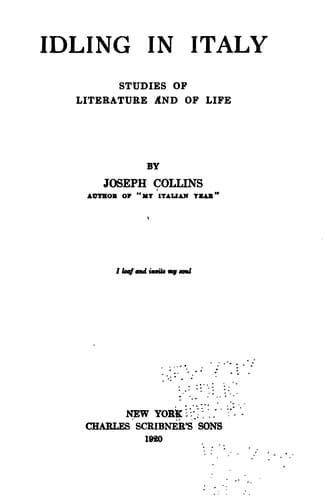
Idling in Italy: Studies of literature and of lifeCollins, Joseph
History
Idling in Italy: Studies of literature and of life
Collins, Joseph
Italian literature -- History and criticism
The next day I went to a midday banquet tendered by Melville E. Stone,
the general manager of the Associated Press, by the newspaper men of
Rome. It was a very different gathering. Newspaper men have a make-up, a
physiognomy, a general appearance, more or less founded in what may be
called personal neglect, that is, an insensitiveness to personal
æsthetics, which is quite characteristic. One can't pick a newspaper man
from a crowd with the same readiness and accuracy that he picks a monk
or an actor, but the majority of journalists become hall-marked after
they have plied their vocation for any considerable length of time. I
was impressed with the appearance of intelligence and seriousness of the
men of the Italian press. Few of them bore the somatic signs of intimacy
with Mr. Barleycorn. The company had a fair sprinkling of ministers,
including Nitti and Gallenga, deputies, and ex-ministers, but as far as
I could see there were no dukes or princes. The latter are ornamental
and not infrequently pleasing to look upon, but a gathering of newspaper
men is redolent of democracy, which is antipathic to princely presence.
We lunched at the restaurant in the Borghese Gardens. It was a much
simpler affair than the banquet tendered the Japs at the Grand Hotel,
but it was an ample, edible lunch, and you had the feeling that we had
foregathered to honor one who was deserving.
When one attempts to describe Mr. Stone he is tempted at once to say he
is a typical American. But what is a typical American? There are so many
types. William Jennings Bryan is a typical American. So is Henry Cabot
Lodge. Benjamin Franklin was a typical American, yet he fraternized with
dukes and flirted with duchesses, the sheer embodiment of _suaviter in
modo_ and _fortiter in re_. While successfully putting America on the
map and advancing the humanities generally, he immortalized himself and
affectioned the French people. Abraham Lincoln, we like to think, was a
typical American, but were one to encounter him incog. in ceremonial
circles, political or social, in Europe to-day, ninety-nine Americans
out of a hundred would deny him. Uncle Sam is supposed to depict the
somatic make-up of the typical Yankee, and at the same time to convey
the idea that he is a man to be reckoned with emotionally and
intellectually at all times, in his moments of relaxation and in his
hours of activity. Nevertheless the average person has something fairly
specific in mind when he says, "He is a typical American." He means a
man who displays and who often can't conceal a determination to put
through that which he has planned; who is self-confident, opinionated, a
stranger to ceremony and oftentimes unfamiliar with ordinary social
amenities; who is fully appreciative of the accomplishments and
potentialities of his country and its institutions, and who doesn't
hesitate to contrast them with those of other countries, often to their
disparagement; who speaks only one language, American, and that not
Public-domain text, read in full here on John Shaqi.
Reviews
Reviews
No reviews yet
Be the first to share your thoughts on this work.
Elsewhere in the archive
Join the Discussion
Join the discussion
Sign in to leave a comment or review.
Sign InorCreate an account