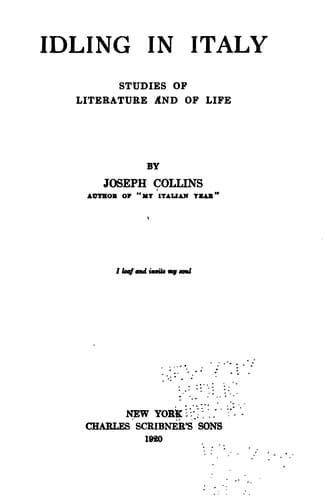
Idling in Italy: Studies of literature and of lifeCollins, Joseph
History
Idling in Italy: Studies of literature and of life
Collins, Joseph
Italian literature -- History and criticism
This morning I determined that I would spend a half-hour in the Church
of S. Onofrio and refresh my recollections of the frescoes of Baldassare
Peruzzi and of Pinturicchio, and pay a tribute to the memory of the
greatest poet of the late Renaissance, Torquato Tasso. On the side of
the steps that lead down to the shoulder of the hill surmounting St.
Peter's is an oak-tree, long since dead, but securely banded and spliced
and propped by indestructible metal. Here, it is said, Tasso sat and
contemplated, too forlorn and ill further to poetize, during those
months of 1594 while he was awaiting his call to the capitol to be
crowned poet laureate. When the illness to which he succumbed increased
to such extent as to incapacitate him he repaired to S. Onofrio "to
begin my conversation in heaven in this elevated place, and in the
society of these holy fathers." It is strange enough that Tasso is a
very real and living force in Italy to-day. Not only are many of his
poems, and selections from them, read in the schools, but "Jerusalem
Delivered" on the screen has recently had a remarkable success in Rome
and in other cities of Italy.
The Convent of S. Onofrio is now scarcely more than a reminder of what
it was in its golden days. Long before the Italian Government had
abolished the right of monasteries to hold property, and therefore
delivered the death-blow to the parasitical grasp which they had upon
this country, the Ospedale Bambini Gesu had taken possession of a large
part of it and converted it into a work of mercy and of salvation which
finds, I fancy, more favor in the eyes of people to-day than does
conventual life. The church, rather impressive from without and
particularly when approached from below, is small and dainty and has
distinctly a spiritual atmosphere. It is what the Italians call _molto
carina_. When I entered the church there was one solitary female
prostrate before an image. I fancied that she had had a troubled night
and had repaired to this sacrosanct environment early in the morning to
purge herself of her sins and to ask forgiveness. For a long time she
remained in an attitude of profound contrition, and I was curious to see
if, on arising, she displayed in feature or in form any evidences or
manifestations of indulgence in those transgressions which we are taught
are so offensive to the Lord. My vigil was rewarded by the sight of age,
deprivation, and poverty. Had pulchritude or passion ever been a part of
her, all sign of them had passed; had sins of commission ever brought to
her riches or the semblance of riches, she had long since forfeited
them; had her transgressions been translated into fugitive pleasures, no
signs of them remained. Like Tasso, she had repaired there to begin the
conversation she hoped to continue in heaven. It is much more likely,
however, that she had gone to church without definite antecedent thought
or determination. It seems to be as much an act of nature for women in
Public-domain text, read in full here on John Shaqi.
Reviews
Reviews
No reviews yet
Be the first to share your thoughts on this work.
Elsewhere in the archive
Join the Discussion
Join the discussion
Sign in to leave a comment or review.
Sign InorCreate an account