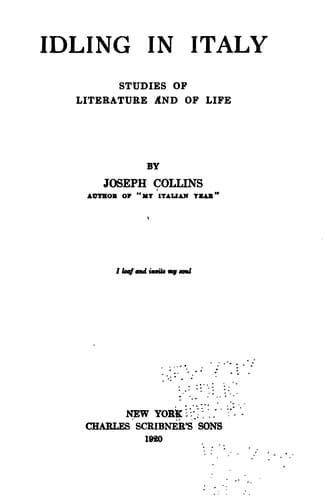
Idling in Italy: Studies of literature and of lifeCollins, Joseph
History
Idling in Italy: Studies of literature and of life
Collins, Joseph
Italian literature -- History and criticism
From here my route is to the Corso, which at this early hour is nearly
deserted. There are many streets that I may take: one that leads to the
Pantheon; another that goes past the Palazzo Madama and other
interesting public and private buildings. As a rule I take the latter,
for it leads me to the Via Condotti, which ends in the Piazza di Spagna.
Before the war this piazza was the rendezvous of American tourists. The
vendors of objects of art and of Roman pearls, the antiquarian who had
his wares fabricated around the corner or in the Trastevere, the dealer
in genuine Raphaels and Tintorettos, the rapacious dealers in old books
are all there, but most of them are on their knees in their shops with
half-closed shutters, praying for the war to end so that the gullible
rich Americans may come again. Their prayers are heard and their
supplications will soon be answered. Meanwhile I cast a glance at the
wretched monument erected a half-century ago to commemorate the
promulgation of the doctrine of the Immaculate Conception, look lovingly
at the semi-sunken boat-shaped fountain just in front of the steps, and
begin slowly to mount the most impressive steps in Rome, which seem to
lead up like heavenly stairs to the massive, double-belfried Church of
Trinità dei Monti, with the graceful Egyptian obelisk in front of it.
Nowadays the steps are not so picturesque as I have often seen them in
peace time, when lovely artists' models, picturesque loafers and the
exponents of the _dolce far niente_ collected on the steps and made, in
conjunction with the flowers and plants that were exhibited there for
sale, an almost unique picture. It is now deserted save for some
hazardous Greek or Italian who attempts to eke out a living by disposing
of flowers that have been camouflaged to look fresh. Nevertheless the
staircase and its environment make an appeal which repeated visits serve
only to increase. From the top of it, in the little square in front of
the church, one gets an attractive, though limited, view of the city and
of Monte Mario, but it is a view that convinces him that he is in a city
quite unlike any other in the world.
A picturesque old woman who sells papers at the bottom of the stairs has
made a regular customer out of me, and I scan the morning news as I
ascend the steps, and by the time I have reached the top I find thoughts
of beauty and of the good old days are being replaced by thoughts of
work and of the war. As I walk across the Pincian Hill I am conscious
that I am big with joy at what the past twenty-four hours have
accomplished at the battle-front, and throbbing with anticipation of
what the following day will bring forth. That it will soon bring
victory, complete and absolute, even the professional warrior is now
forced to admit, and soon we shall bask again in the light of a livable
world.
CHAPTER XVIII
THE AMERICAN EAGLE CHANGES HIS PERCH
Public-domain text, read in full here on John Shaqi.
Reviews
Reviews
No reviews yet
Be the first to share your thoughts on this work.
Elsewhere in the archive
Join the Discussion
Join the discussion
Sign in to leave a comment or review.
Sign InorCreate an account