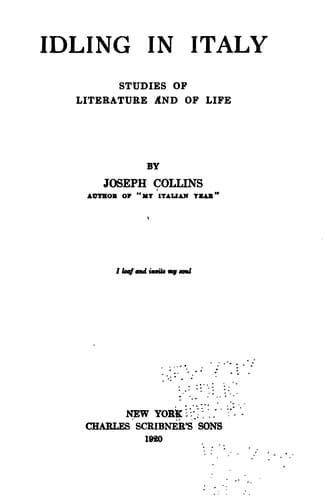
Idling in Italy: Studies of literature and of lifeCollins, Joseph
History
Idling in Italy: Studies of literature and of life
Collins, Joseph
Italian literature -- History and criticism
If we had entered the war after the sinking of the _Lusitania_, when the
wise men of the West say we should have gone in, countless lives and
inestimable expenditures would have been spared. Where is the man in the
United States of America to-day who has revealed the Jove-like mind that
entitles him to make such sentient statement? When he is found, how can
he possibly know? What delivery of thought, idea, conception, execution
has he ever made that entitles him to be heard, not to say believed? How
can any one possibly know what would have been the result of our
entrance into the war at that time? If any one thing is responsible for
America's efficiency in the war, it is that it had the American people
fused into one man with one mind, determined to win the war. I am sure
that I encountered nothing in the United States in my travel from the
Atlantic to the Pacific and back again in the spring of 1916 that made
me believe that the people of our country wanted war, or that there
could be developed in them at that time a sentiment which would make for
such internal resistance of the people as they displayed in the spring
of 1917 and continued to display until November 11, 1918. I cannot speak
from personal knowledge, for I was not in the United States during the
year of its war efficiency, but I am told that there was never a whisper
of disloyalty or a syllable of disparagement of the President personally
during that time. But many of those who were silent then are strident
now. Their enforced silence has enhanced the carry-power of their
voices, and their clamor prevents the harmony that the world is seeking.
They not only defame Wilson, but they contend that the part we played in
the war has been overestimated. It has been, but not by us. It has been
evaluated by those whom it was our most sacred privilege to aid. They
neither minimize our efforts not underestimate our accomplishment. The
British know that they were steadfast; the French realize that they were
resolute; the Italians appreciate that they were brave. We know it, but
that does not prevent us from realizing the magnitude of the rôle we
played, and the man who was responsible for it is the man to whom the
world, save a political party in the United States, gives thanks and
expresses appreciation. His name is Woodrow Wilson. Americans do not
boast of the part they played in winning the war, but they do encourage
that which is far worse than boasting--lying about it, particularly when
the motive for such perversion of truth is deprecation of their Chief
Executive.
Public-domain text, read in full here on John Shaqi.
Reviews
Reviews
No reviews yet
Be the first to share your thoughts on this work.
Elsewhere in the archive
Join the Discussion
Join the discussion
Sign in to leave a comment or review.
Sign InorCreate an account