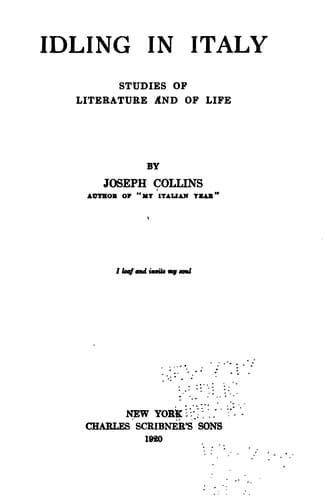
Idling in Italy: Studies of literature and of lifeCollins, Joseph
History
Idling in Italy: Studies of literature and of life
Collins, Joseph
Italian literature -- History and criticism
He has been accused of not surrounding himself with the ablest men of
his party or of the country, in the conduct of the affairs of the nation
during the period when the country was emerging from the position of
aloofness from world politics which it had maintained from the time
Washington warned of the danger of "entangling foreign alliances." But
it does not convince me that a man is not competent to do the job that
the President has given him because his training has been as a
stockbroker and his activities on the bear side of the market. That is
not the kind of training that one would give his son whom he wished to
see become a statesman, but it occurs to me that the task entrusted to
him may be one which a statesman is not best fitted to handle. It may be
a job that a man with the mentality and training and moral possessions
that he selected could do better than any one else.
What earnest of superior constructive, intellectual powers has any
public man in the United States displayed that justifies
self-constituted critics in saying that the men selected by President
Wilson are not their peers? It is universally admitted that President
Wilson has a more masterful and comprehensive grasp of politics in
America, using that word in its conventional, every-day sense and
meaning, particularly a familiarity with bosses and the "machine," than
any President ever had. No one denies his statesmanship. He is,
therefore, a competent judge of who was best fitted to do the work which
it was necessary to do in order that the programme which he formulated
for the benefit of humanity might be executed, and particularly that the
yoke might be lifted from the necks of the oppressed nations and that
another world calamity in the shape of war might be avoided. His choice
of aides and representatives was not acceptable to men who put party
interests before public interests, who are willing to sacrifice world
weal for worldly advancement, and who lash themselves into a frenzied
state by repetition of the admonitions of Washington or Monroe. It does
not detract from the glory of the father of his country, or from the
lustre of great interpreters of national law, to say that the principles
that they enunciated and the practices that they initiated centuries ago
are not necessarily those that should guide us now. It would be just as
legitimate to say that physicians should follow the teachings of
Hippocrates or Galen, because the one was the father of medicine and the
other its greatest expositor, as it would to say that we must follow
slavishly the teachings of Washington and Monroe.
Public-domain text, read in full here on John Shaqi.
Reviews
Reviews
No reviews yet
Be the first to share your thoughts on this work.
Elsewhere in the archive
Join the Discussion
Join the discussion
Sign in to leave a comment or review.
Sign InorCreate an account