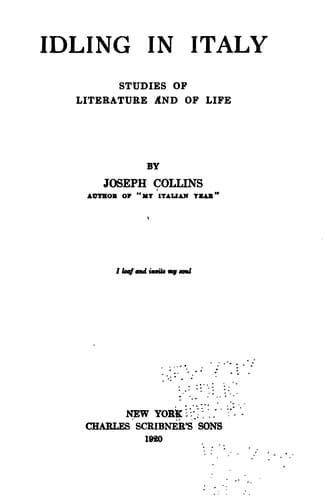
Idling in Italy: Studies of literature and of lifeCollins, Joseph
History
Idling in Italy: Studies of literature and of life
Collins, Joseph
Italian literature -- History and criticism
In reality it is a cross between a philosophic treatise and a popular
polemic, with the technical abstruseness of the one and the passion of
the other, and its purpose is to show that all philosophy is vain and
should make way for action. Although it indicates wide and attentive
reading and a certain erudition, the only indication of constructive
thought that it reveals is a rudimentary attempt to adjust the
philosophic system of each man to the temperamental bias of the author.
Others, Santayana for instance, have done this so much better that there
is scarcely justification for his pride. He could have carried his point
quite as successfully by stating it as by laboring it through a whole
volume devoted largely to railing both at philosophers and at their
philosophy.
From the point of view of the philosopher this book is "popular." From
the standpoint of the people it is "philosophical." It is really a
testimonial to the author's breathless state of emotional unrest. He is
like a bird in a cage and he feels that he must beat down the barriers
in order to accomplish freedom, but when they are fractured and he is
apparently free there is no sense of liberation. He is in a far more
secure prison than he was before, and to make matters worse he cannot
now distinguish the barriers that obstacle his freedom. The wonder is
not that a man of the temperament and intellectual endowment of Signor
Papini has this feeling, but that he can convince himself that any one
else should be interested in his discovery.
He that hath knowledge spareth his words, and the mistake is to consider
words linked up as subject, predicate, and object, especially if the
substantives are qualified by lurid adjectives, the equivalent of
knowledge. He knows the "ars scrivendi" as Aspasia knew the "ars
amandi"; Papini knows the value of symbolic, eye-arresting, suggestive
titles. He realizes the importance of overstatement and of exaggerated
emphasis; he is cognizant of the insatiateness of the average human
being for gossip and particularly gossip about the great; he recognizes
that there is no more successful way of flattering the mediocre than by
pointing out to him the shortcomings of the gods, for thus does he
identify their possessions with his own and convince himself that he
also is a god. Papini's sensitive soul whispers to him that the majority
of people will think him brave, courageous, valorous, resolute,
virtuous, and firm if he will adopt a certain pose, a certain manner, a
certain swagger that will convey his grim determination to carry his
mission to the world though it takes his last breath, the last glow of
his mortal soul.
Public-domain text, read in full here on John Shaqi.
Reviews
Reviews
No reviews yet
Be the first to share your thoughts on this work.
Elsewhere in the archive
Join the Discussion
Join the discussion
Sign in to leave a comment or review.
Sign InorCreate an account