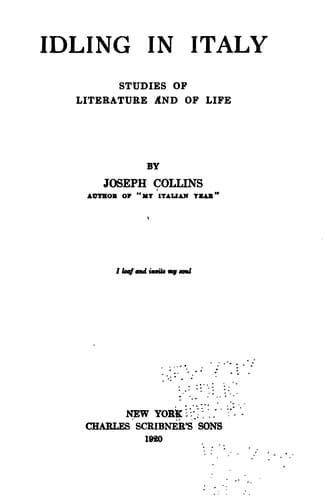
Idling in Italy: Studies of literature and of lifeCollins, Joseph
History
Idling in Italy: Studies of literature and of life
Collins, Joseph
Italian literature -- History and criticism
"They wished me to be a poet; here, therefore, is a little poetry," is
the opening line of his book called "Cento Pagine di Poesia," and this,
though not in verse, is characterized by such imaginative beauty, more
in language, however, than in thought, that it is worthy to be called a
poem. More than any other of his books it reveals the real Papini. Here
he is less truculent, less Nietzschian, less self-conscious of
understudying and attempting to act the parts of Jove. He is more like
the Papini that he is by nature, and therefore more human, more kind and
gentle--would I could add modest--more potent and convincing, than in
any of his other books. It is especially in the third part, under the
general title of "Precipitations," that the author gives the freest rein
to his fantasy and is not always endeavoring to explain or tell the
reason why, but abandons himself to the production of words which will
present rhythmically the emotions that are springing up within him. It
is difficult to believe that the same hand penned these poems and the
open letter to Anatole France beginning: "In these days Anatole France
is in Rome, and perhaps returning he will stop in Florence, but I beg
him fervently not to seek me out. I could not receive him." That quality
of delusion of grandeur I have seen heretofore only in victims of a
terrible disease.
Signor Papini is never so transparent as he is in his "Stroncatura" and
in his excursions into the realm of philosophy. His attack on Nietzsche
is most illuminating. In fact, Giovanni Papini is Frederick Nietzsche
viewed through an inverted telescope. "Nietzsche's volubility
(indication of easy fatigue) makes him prefer the fragmentary and
aphoristic style of expression; his incapacity to select from all that
which he has thought and written leads him to publish a quantity of
useless and repeated thought; his reluctance to synthetize, to
construct, to organize, which gives to his books an air of oriental
stuff, a mixture of old rags and of precious drapery, jumbled up without
order, are the best arguments for imputing to him a deficiency of
imperial mentality, a reflex of the general weakness of philosophy. But
the most unexpected proof of this weakness consists in his incapacity to
be truly and authentically original. The highest and most difficult
forms of originality are certainly these two: to find new interpretation
and solution of old problems, to pose new problems and to open streets
absolutely unknown."
Public-domain text, read in full here on John Shaqi.
Reviews
Reviews
No reviews yet
Be the first to share your thoughts on this work.
Elsewhere in the archive
Join the Discussion
Join the discussion
Sign in to leave a comment or review.
Sign InorCreate an account