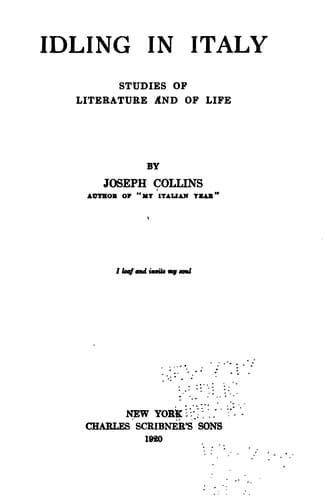
Idling in Italy: Studies of literature and of lifeCollins, Joseph
History
Idling in Italy: Studies of literature and of life
Collins, Joseph
Italian literature -- History and criticism
The acceptable fiction of to-day will reflect in some measure the world
thought, or it will soothe man's cravings for assurance of future life
and strengthen his belief in it. It is idle to deny that the pitch of
man's thought to-day is materialistic, though his unconscious mind is
steeped in the mystic. Could we but teach future generations the
pleasure-potency of the imagination, we should give them an asset that
would enhance the usefulness and efficiency of their lives comparable to
health. But for some years at least there has been a mistaken notion
that the chief sources of pleasure are responding to the call of the
instincts, the fortuitous offerings of chance, and awaiting the day when
the vital sap will return from the branches of that universal tree upon
which we are the leaves to the trunk, that the spirit may be restored to
the Infinite. "Poor vaunt of life, indeed, were man but formed to feed
on joy, to solely seek and find and feast."
Pedagogy has never concerned itself with our imaginative life. That is
left to endowment and to chance, which sometimes shows itself in the
shape of a literary critic. Fortunate, indeed, is the people or nation
that breeds competent critics, it matters not what field of activity
they cultivate, letters, science, or theology. Italy has had many such,
but there is a greater dearth of them now than ever before. With the
exception of Benedetto Croce there is perhaps no one of more than
national reputation.
It is, perhaps, unwise to select from the considerable number of
present-day literary critics the names of a few, but I hazard it. Emilio
Cecchi, of the Rome _Tribuna_, is a versatile, scholarly writer, a
thoughtful, judicious estimator of his fellow writers' works, and a
critic who is not obsessed with the impulse that is supposed to dominate
a certain type of Irishman, namely, to hit a head whenever he sees it.
Giuseppe Prezzolini, who has been very intimate with the Florentine
group headed by Papini and who has written a critical estimate of his
writings and made a glowing statement of his personal charms, has a
sympathy and admiration for the writers of what may be called the new
school. That does not prevent him from being a keen observer, a logical
thinker with a judicious capacity to weigh the evidence presented by his
fellow writers in their claim for popularity and fame. He is a type of
literary man new to Italy, a keen critic, a clear thinker, a master of
literary expression who devotes much of his energy to his
publishing-house and to _La Voce_. His writings are chiefly political
and critical, "Il Sarto Spirituale" ("The Spiritual Tailor"), "L'Arte di
Persuadere" ("The Art of Persuading"), "Cos' è il Modernismo?" ("What is
Modernism?"). He has done more to introduce and bring forward the potent
group of young writers than any one in Italy.
Public-domain text, read in full here on John Shaqi.
Reviews
Reviews
No reviews yet
Be the first to share your thoughts on this work.
Elsewhere in the archive
Join the Discussion
Join the discussion
Sign in to leave a comment or review.
Sign InorCreate an account