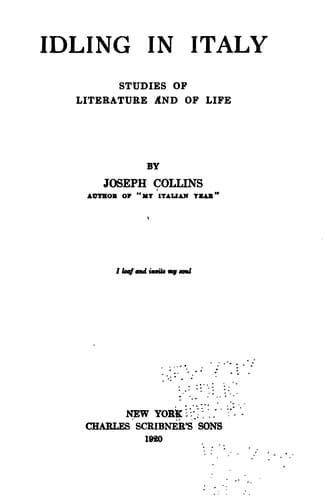
Idling in Italy: Studies of literature and of lifeCollins, Joseph
History
Idling in Italy: Studies of literature and of life
Collins, Joseph
Italian literature -- History and criticism
infraction of convention is conditioned more by environment than by
determination.
"L'Amore non c'è più" ("There Is No More Love") and "Il Maleficio
occulto" ("Witchcraft") are other popular romances.
Virgilio Brocchi is a similar writer, though his writings have never had
similar popularity. His most meritorious books have been "Mite" and "Le
Aquile." His later books, such as "Isola Sonante," show the author's
progress in literary craftsmanship. His last book, "Secondo il Cuor mio"
("According to My Heart"), shows that he has had his ear to the ground
and has noticed that the chariot labelled "Public Taste in Letters" is
being driven on a new road. There is a note of idealism in the conduct
of Gigi Leoni, the artist passionately devoted to his art, in love with
Merine Dialli, proud and rich; he refuses to accept her suggestion that
he relinquish his art and do something that will lead to material
success. After she has made a failure in matrimony with an army officer
and returns to the artist, Zuccoli succeeds in drawing with masterly
strokes the portrait of a real hero, who, when he perishes later on the
field of battle, excites unreservedly the admiration of his readers. In
reality it is a book in which passion, of life or of the senses, as it
sways an attractive man full of nobility and of dreams, is depicted in
the traditional idealistic manner.
The Harold Bell Wright of Italian fiction is Guido Da Verona, and this
does Mr. Wright an injustice, for he has never written pornographically
and Signor Da Verona has rarely written otherwise. But he is Italy's
best-seller. It is depressing to think that really great romances, like
the "I Malavoglia" of Verga, stories such as Capuana's "Passa L'Amore,"
or Renato Fucini's, or even Panzini's "La Madonna di Mamà," should have
a sale of only a few thousand copies, while books of the character of
"Mimi Bluette," the flower of Signor Da Verona's garden, should go up
toward the hundred-thousand mark. It is an index of the salaciousness of
the average person, whoever he may be. Any review of Italy's recent
literature must mention "The Woman Who Invented Love," "Life Begins
To-morrow," if for no other purpose than to show that there is a kind of
literature in every country which has a great popularity. In Belgium its
clientele is found in the prurient of other countries; in France the
"best people" do not read it or say they do not; in England the public
censor prohibits it; and we have Mr. Comstock and his successors.
"Madeline," which has recently cost its guiltless publisher a fine, is
"soft stuff" compared with "Mimi Bluette," and I doubt if Mr. George
Moore could revoke any memories of his dead life that could hold a
candle to some of Signor Da Verona's actual life.
Public-domain text, read in full here on John Shaqi.
Reviews
Reviews
No reviews yet
Be the first to share your thoughts on this work.
Elsewhere in the archive
Join the Discussion
Join the discussion
Sign in to leave a comment or review.
Sign InorCreate an account