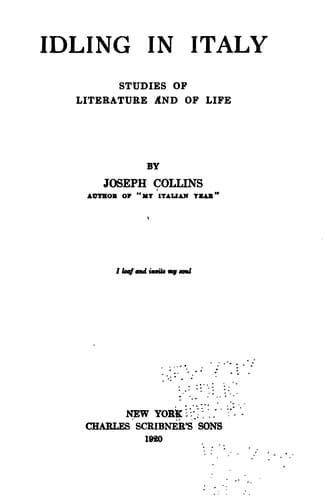
Idling in Italy: Studies of literature and of lifeCollins, Joseph
History
Idling in Italy: Studies of literature and of life
Collins, Joseph
Italian literature -- History and criticism
I could not have better illustrations of the rôle played by
autobiography in modern fiction than two recent novels--one by Michele
Sapanaro, "Peccato" or "Six Months of Rustic Life"; the other by
Frederigo Tozzi, "Con gli Occhi Chiusi" ("With Closed Eyes"). The first
is a fresh, ingenuous book with a vein of romanticism which does not run
into great effusion or great amativeness, in which is depicted the
atmosphere, environment, and inhabitants of a small community in
southern Italy, whither the writer has gone to visit his peasant brother
and to recover from some of the wounds inflicted upon him in
transformation from peasant to "gentleman." It is undoubtedly an
elaborated, embellished chapter of the author's life.
That "With Closed Eyes," a novel of provincial and peasant life in
Tuscany, is wholly autobiographical, we have the testimony of a fellow
Tuscan who says of Signor Tozzi that he first met him when he was a
waiter in his father's tavern. Lazy, slothful, unkempt, and of coarse
appearance, he had a passion for reading Angiolieri and Verlaine. He was
radical, socially and politically. After a colorless, misspent youth
beyond authority, parental or communal, he began newspaper work, the
stepping-stones of so many Italian writers of to-day. The discipline of
military life and the environment of Rome effected a change in his
outward appearance, and the composition of his book, "Bestie"
("Beasts"), which the church put on the Index, helped him spiritually.
"With Closed Eyes" is a narrative of his life, sordid, ugly,
commonplace, revealing, however, a gradual spiritual uplift and
refinement. It was not until the publication of "Tre Croci" that he was
much discussed. Competent critics such as Signor Borghese think that
Italy's most promising literary light was extinguished when Frederigo
Tozzi died in Rome, in March, 1920. His literary output was not great
for a man who had lived thirty-eight years, but it can truthfully be
said that each succeeding volume from his pen showed that he was likely
one day to be Verga's successor in the literary primacy of Italy. His
last romance, "Il Podere," ("The Farm,") has not yet appeared in book
form.
One cannot always judge from first performances the potentialities of a
writer. A few years ago Rosso di San Secondo, a young Sicilian,
published "Io Commemoro Loletta" ("I Commemorate Loletta"), a series of
short stories which in substance and in workmanship showed not only no
talent but no promise of talent. In reality they seemed to show an
absence of artistic capacity, architectural ability, and literary taste.
A year later "La Bella Addormentata" ("The Sleeping Beauty"), a
coloristic, mystic drama, a strange mixture of Plotinus and Dionysius,
revealed real talent.
Public-domain text, read in full here on John Shaqi.
Reviews
Reviews
No reviews yet
Be the first to share your thoughts on this work.
Elsewhere in the archive
Join the Discussion
Join the discussion
Sign in to leave a comment or review.
Sign InorCreate an account