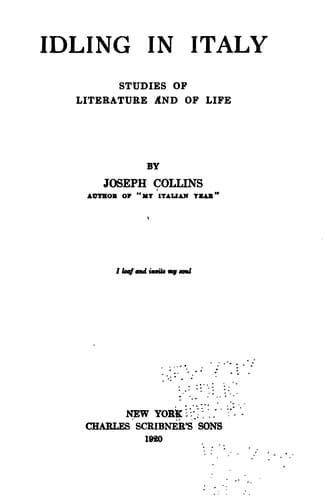
Idling in Italy: Studies of literature and of lifeCollins, Joseph
History
Idling in Italy: Studies of literature and of life
Collins, Joseph
Italian literature -- History and criticism
Often I find myself thinking of the justification of autobiographical
writing in fiction. The modern Italian writer is devoted to it.
D'Annunzio set the example a generation ago and carried it to such a
point that he outraged all sense of decency. So long as he confined
himself to revelation of his own alleged amatory potency and mastery of
the arts of love, even though he trampled upon sacred ideals, the public
tolerated it. When he strained the sensualities of well-known and
beloved notabilities through the percolators of his perverse imagination
they sickened of him and denounced him. It is an exquisite form of
self-appreciation--the belief that the commonplace events, deliberate
thoughts, and vagrant fancies of an individual who has in no way
distinguished himself will divert and instruct others, and that they are
worthy of record. The fact that such writings are bought is the
justification they allege. But the public is like the editor of a
magazine. He has to read reams of trash to find one worthy and
acceptable contribution. The purpose of fiction may be manifold, but it
is read chiefly for distraction and diversion. The critic and
interpreter read it to get the temper of the public mind and the trend
of its projection, but the purchaser of it reads it to get surcease of
the woes of life, whether they be the ruts worn by operating the daily
treadmill or the despondencies thrust upon him by circumstances more
inexorable than the tigers of Hyrcania. It is not likely that the
occurrences in the life of another commonplace individual even though
they are pieced with fiction will suffice to provide this. Therefore
those who turn to the narration of the lives of others in which there
have been stirring events, picturesque phases, and romantic incidents
are likely to have greater success. Whether it is a legitimate procedure
is another question. It is a matter of taste. It was as justifiable for
Mr. Somerset Maugham to portray Paul Gauguin in "The Moon and Sixpence"
as it was for Mr. Morley Roberts to describe George Gissing in "The
Private Life of Henry Maitland," and even more so, for the latter had
revealed himself adequately in his books. Nothing was to be gained by
raking up a past that led through prison any more than the prison days
of O. Henry is an asset of immortality. Sometimes such writings have a
meritoriousness apart from their literary qualities. The "Green
Carnation" did much to inform Britishers how prevalent and pernicious
was the vice which its prototype was afterward locked in Reading Gaol
for practising and apotheosizing. To take a man whose fame has mounted
steadily since his death and make a monster of him is a hazardous and,
many will think, an iniquitous thing to do, even though the individual
during his lifetime was unmoral and immoral. This is what Mr. Somerset
Maugham has done for Paul Gauguin, master of the Pont Aven school of
painting; dislocater of impressionism and neo-impressionism; liberator
Public-domain text, read in full here on John Shaqi.
Reviews
Reviews
No reviews yet
Be the first to share your thoughts on this work.
Elsewhere in the archive
Join the Discussion
Join the discussion
Sign in to leave a comment or review.
Sign InorCreate an account