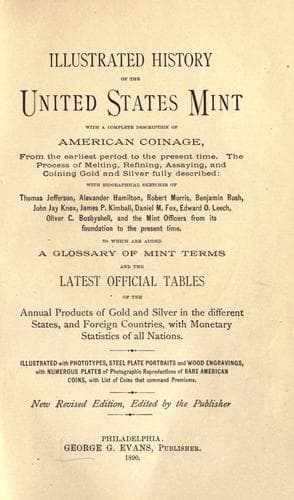
Illustrated history of the United States mint: with a complete description of American coinage, from the earliest period to the present time
History
Illustrated history of the United States mint: with a complete description of American coinage, from the earliest period to the present time
Coinage -- United States; Mints -- United States
On the 12th of July, 1876, Congress passed a bill authorizing the
President to appoint a Commission of three civilians to investigate the
subject and make report upon it. Mr. Fox was one of the appointees,
his colleagues being selected from other States. The Commission, in
the exercise of its functions, visited every section of the country,
embracing a distance of travel of over twenty-eight thousand miles.
Sessions were held in all the principal cities, much testimony taken,
and when its labors were completed a report of great value was prepared
and presented, which went far towards a satisfactory settlement of the
controversy.
[From The History of the Philadelphia Police.]
One of the most important occurrences during Mr. Fox’s term as
Mayor was the abolition of the old Volunteer Fire Department.
The ordinance for the erection of a Paid Fire department was
passed December 29, 1870, after a series of hot debates. The
old volunteers were a power in politics, but their acts of
violence and incendiarism made it imperative in the opinion
of a majority of citizens that they should be superseded. The
passage of the ordinance caused a sensation because it was not
believed that Councils would dare to abolish the volunteers.
Feeling ran high. The firemen held meeting after meeting in
their engine-houses. All attention was directed towards the
Mayor. Would he sign the ordinance and make it a law? He had
ten days in which to consider the bill. He was known to favor
it; but day after day passed and he took no action. Meanwhile
he was not asleep. He had perfected police arrangements whereby
the whole force could be called out at once on the outbreak
of any violence, and the excitement was so great that the
rowdy element and the firemen were expected to sally forth at
any moment. There were two or three isolated outrages, but
no general riot. The ten days drew towards a close and the
excitement became less intense every day. It was with this
object in view that the Mayor delayed signing the ordinance. He
waited until the last day before putting his signature to the
bill. The volunteers had become in a degree reconciled to the
measure, and some of them hoped to resume work with engine and
hook-and-ladder under the new system.
The old volunteer firemen now hold Mr. Fox in high esteem.
At the great fire in Newhall, Borie & Co.’s sugar refinery,
which stood at the corner of Race and Crown streets, the lives
of a number of the volunteers were endangered through their
own stubbornness, and only saved through determined action
on the part of the Mayor. The engine-house of the refinery
was a single story building facing on Crown street; over it
was a projection five or six stories in height containing the
hoisting apparatus and other machinery of great weight.
HIS WATCHFUL CARE SAVES MANY LIVES.
Public-domain text, read in full here on John Shaqi.
Reviews
Reviews
No reviews yet
Be the first to share your thoughts on this work.
Elsewhere in the archive
Join the Discussion
Join the discussion
Sign in to leave a comment or review.
Sign InorCreate an account