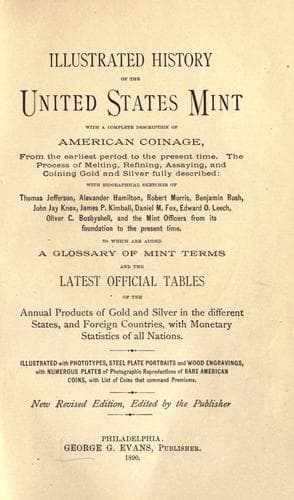
Illustrated history of the United States mint: with a complete description of American coinage, from the earliest period to the present time
History
Illustrated history of the United States mint: with a complete description of American coinage, from the earliest period to the present time
Coinage -- United States; Mints -- United States
“Peltry,” we learn, was one of the principal articles of currency, and
was known as “pelt,” or Massachusetts currency, and was extensively used
in trading between Indians and whites, sometimes called “Beaver Money,”
“Corne, Wheate, Barley, and Rye;” and a still more quaint currency was
established, as will be found in an old Massachusetts court order, as
follows: “_It is likewise ordered that muskett balletts of a full boare
shall passe current for a farthing a peece, provided that noe man be
compelled to take above 12d. att a tyme of them._”
In Maryland, not only cattle, tobacco, and other produce was accepted
as currency, but powder and shot were also included. Lord Baltimore, in
1660, sent over to Maryland the “Baltimore” shilling. In the colonial
case there is a series of these exceedingly rare coins. They were a
shilling, sixpence, groats, and are all of the same design, differing
only in denomination. They were coined in London, and compare favorably
with any minting of that age. The bust of Lord Baltimore on the obverse
is very well cut; his name “Cecil,” is the legend. On the reverse, the
coat of arms of Cecil, Lord Baltimore, is given; this device has been
re-adopted by the State of Maryland. The substitution of any legal tender
seems to be fraught with danger, and at best is jealously scanned by
the people; and there was trouble to put this coin into circulation.
The people, though demanding coin, did not yield their old currency of
“_wheat, corn, tobacco, powder, and shot_,” without a demonstration.
The Carolinas, Virginia, and New Hampshire all followed Maryland in the
introduction of a colonial coinage.
In the interval of the Revolution, known as the Confederacy, the growth
of the spirit of independence in the people is plainly written on their
coins, especially upon their tokens or individual coins. We notice
one inscription attributed to Franklin, “_Mind your business_;” and
others, such as “_Good copper_,” “_Cut your way through_,” and like
characteristic expressions. The “New York Doubloon” was coined in 1787,
value sixteen dollars. This coin is highly esteemed by reason of its
rarity, and its market value to-day is about five hundred dollars, as
only three or four are known to be in existence.
The Washington cent of 1791 (so-called) was not a coin of the United
States, but was struck at a private mint in Birmingham, England,
(Boulton’s), partly, no doubt, to bespeak the “job,” and partly to
_please Americans_ generally.
It has been said that Washington objected to putting his head on the
coins, and it may be true; but it was also objected that no man’s head
should appear on the coin of a republic, which, whether good doctrine or
not, is still the prevailing idea. The “cent of 1791” is of two types,
one very rare and costly, with a small eagle. The other, with a large
eagle, is more common, and perhaps sells for about five dollars at a
public coin sale.
UNITED STATES COINS.
Public-domain text, read in full here on John Shaqi.
Reviews
Reviews
No reviews yet
Be the first to share your thoughts on this work.
Join the Discussion
Join the discussion
Sign in to leave a comment or review.
Sign InorCreate an account