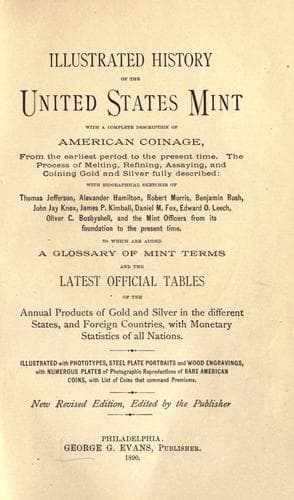
Illustrated history of the United States mint: with a complete description of American coinage, from the earliest period to the present time
History
Illustrated history of the United States mint: with a complete description of American coinage, from the earliest period to the present time
Coinage -- United States; Mints -- United States
_Restrikes._ There were struck at the Mint in 1858 restrikes with plain
edges, of which three were recovered after diligent search; two of these
were destroyed in the Mint, and the other placed in the Cabinet, where it
remains. The difference between these and the originals are as follows:
obverse, the original die was re-cut in the word LIBERTY, the stars and
date, which made them larger and deeper, especially noticeable in the
stars, which are broadened; also in the date, it making the outline sharp
and square, whereas in the originals they are somewhat rounded; reverse,
not having the original die, they used another, which differs in many
respects, most easily noticeable in that the A touches the eagle’s claw,
the OF much nearer of the end of eagle’s wing than S in States (in the
original it is equally spaced); edge, plain; weight, 381.5 grains. One
specimen is in the Mint and another in England,—struck between 1860 and
1869, as in the latter year all dies remaining were destroyed, same as
the above, but endeavors were made to letter the edges in the absence of
a complete collar by using pieces of collars which did not contain all
the letters, but repeated some of them several times. There was one of
these pieces sold in the Berg collection in 1883 for $740, and showed all
the peculiarities mentioned, and its weight was said to be inaccurate.
The dies were destroyed in the winter of 1868-69. No counterfeit dies of
the 1804 dollar were ever made. After the close of each year all dies are
now destroyed.
DOUBLE EAGLE.
Among the rare coins in the Cabinet at the Mint is a Double Eagle. The
dies for this piece were made in 1849, and only one was struck. “UNIQUE”
and beyond price. There is also a Quarter Eagle of 1842, and the only one
known extant at the Mint.
SELECTIONS.
Having referred many times to this case, it may be as well to append the
entire list of its contents, as they, almost without exception, are rare,
spanning the world from remotest antiquity to the present day, beginning
with the gold Daric of Darius, and ending with the twenty-mark piece of
Kaiser William.
GREECE.
1. Four drachma, Athens, B. C. 500; 2. Oboloi of Athens; 3. One-half
obolos, 1⅓ of a cent; 4. Daric, Darius, of Persia, B. C. 520, value, five
dollars and fifty cents; 5. Silver Daric; 6. Brass Ob. Berenice, B. C.
284; 7. Ptolemy and Berenice, copy; 8. Maneh of Ptolemy Philadelphus,
B. C. 284, value, $17.70; 9. Drachma, Cyrene, B. C. 322; 10. Coin of
Syracuse, copy, about B. C. 300; 11. Silver coin, Bactria, B. C. 126; 12.
Brass of Bactria, B. C. 180; 13. Cleopatra, B. C. 30; 13_a_. Denarius of
Cleopatra and Mark Antony; 14. Alexander the Great, B. C. 36; 15. Philip,
B. C. 323; 16. Stater of Seleucus; 17. Alexander Balas, B. C. 150; 18.
Antiochus VI; 19. Philip, King of Syria, B. C. 93.
ROME.
Public-domain text, read in full here on John Shaqi.
Reviews
Reviews
No reviews yet
Be the first to share your thoughts on this work.
Join the Discussion
Join the discussion
Sign in to leave a comment or review.
Sign InorCreate an account