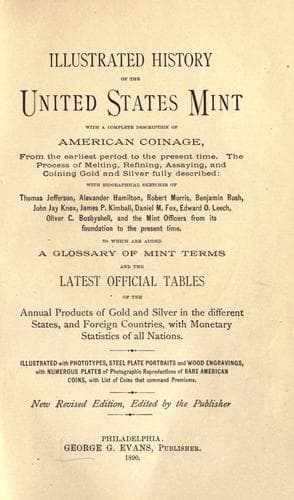
Illustrated history of the United States mint: with a complete description of American coinage, from the earliest period to the present time
History
Illustrated history of the United States mint: with a complete description of American coinage, from the earliest period to the present time
Coinage -- United States; Mints -- United States
20. Roman aes, B. C. 500; 21. Denarius of Augustus, B. C. 31; 22.
Tiberius, A. D. 14; 23. Simon, Bar Cochab, false Christ, A. D. 133; 24.
Vespasian, A. D. 49; 25. Gold bezants, A. D. 610; 26. Justinian, A. D.
527; 26_a_. Kingdom of Cyprus and Jerusalem, Peter 1, 1361 to 1372,
testoon, Kingdom of Jerusalem; 26_b_. Amaury II., 1194 to 1205.
ENGLISH.
27. Gold of Britain; 28. Carausius, Roman Emperor of Britain, A. D.
287; 29. Penny of Ethelbert, King of Kent, 858 A. D.; 30. Harold the
Dane, A. D. 1036; 31. William the Conqueror, 1066, A. D.; 32. Edward the
Confessor, A. D. 1041; 33. Robert the Bruce, A. D. 1306; 34. Elizabeth,
Double Ryal, A. D. 1558; 35. James I, 1603, Ryal (30 shillings) and
sovereign; 36. Charles I, sovereign; 37. Siege pound of Charles I, 1642;
37_a_. Gold sovereign of Oliver Cromwell; 38. Crown, and half crown and
shilling, Oliver Cromwell, 1658; 38_a_. Farthing, Queen Anne; 39. George
IV; 40. Coins of Australia.
FRANCE.
41. Deniers of Charlemagne, 806; 42. Medalet, Marie Antoinette; 43. Five
francs, Napoleon I; 44. Gold, Napoleon I, 1851; 45. Five francs, Paris
Commune.
GERMANY.
46. Bracteats; 47. German Crown, Ob. St. Stephen; 48. Ducat, Ob. Luther
and Melanchthon, 1730; 49. Crown, Maximilian, A. D. 1615; 50. Ducat,
Nuremburg; 51. Ducat Hamburg; 52. Monument, Bavaria; 53. King’s family,
Bavaria; 54. Coins of Prussia; 55. Silver piece, Frederick William and
Augusta.
SPAIN.
56. Ferdinand and Isabella; 57. Charles II., Spain; 58. Alphonso, Spain.
ITALY.
59. Silver of Venice under the Doges, twelfth century; 60. Ducat of
Venice; 61. Copper of San Marino; 62. Silver piece of Lombardy; 63. Gold
twenty lira piece; 64. Swiss crown, ob. St. Vincent; 65. African shell
money; 66. African ring money.
ORIENTAL.
67. Siamese coins; 68. Chinese tael; 69. Widow’s mite; 70. Jewish shekel;
70_a_. Herod the Great, 37 B C.; 70_b_. Herod Archelaus, 4 B. C.; 71.
Glass coin, Egypt; 72. Gold of Alnaser, A. D. 1222; 73. Dirhem of Mahomet
V., A. D. 854; 74. Dirhem of Walid, Caliph of Damascus, A. D. 713; 75.
Haroun Alraschid, Koran text, 806; 76. Fire Worshippers, A. D. 300; 77.
Gold of Japan, 1634; 78. Gravel stone of Burmah; 79. Late coin of Turkey;
80. Mexican dollar used in China; 81. Coin of Cochin China.
The most notable coin in this case, and perhaps the most celebrated coin
in the world, is the “Widow’s Mite.” Its name bespeaks its commercial
insignificance. Yet visitors every day, upon entering the Cabinet of the
Mint, ask first to see the “Widow’s Mite.”
The following letter from Wm. E. Du Bois, will be found of interest to
the reader.
THE WIDOW’S MITE.
SIR: The curators of the mint cabinet do not consent to the
intimation in a statement recently made that their widow’s mite
is not the real coin.
The expression of a doubt as to any received fact is thought
to be a sign of superior insight. Hence we have so much
“destructive criticism,” a good deal of it being fatal to the
critic himself.
Public-domain text, read in full here on John Shaqi.
Reviews
Reviews
No reviews yet
Be the first to share your thoughts on this work.
Join the Discussion
Join the discussion
Sign in to leave a comment or review.
Sign InorCreate an account